
LSA-2200
Base for statue of Titus Flavius Frontinus Heraclius, priest and duovir. Lepcis Magna (Tripolitania). Earlier fourth century
Record details
Photographs
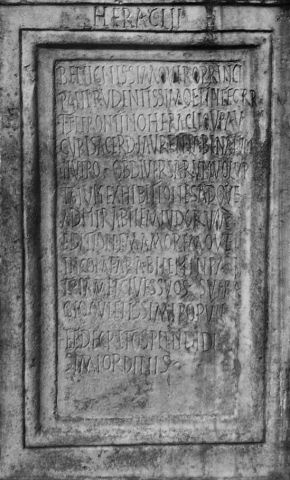
Inscription
Heraclii. / Benignissimo viro princi/pali prudentissimo et integrr(imo) (sic, for 'integerrimo'), /(4) T(ito) Fl(avio) Frontino Heraclio v(iro) p(erfectissimo), au/guri, sacerd(oti) Lauren(tium) Labinat(i)um, / IIviro, ob diversarum volup/tatum exhibitiones adque / admirabilem ludorum / editionem, amoremque /(10) incomparabilem in pa/triam et cives suos, (vac. c.3) sufra/gio quietissimi populi / et decreto splendidis/simi ordinis.
Inscription translation
(Statue of) Heraclius. To the most benign principalis, most prudent and most untainted, Titus Flavius Frontinus Heraclius, of perfectissimus rank, augur, priest of the Laurentes Lavinates, duovir. On account of the granting of various spectacles and the admirable giving of games, and of his incomparable love towards his fatherland and his citizens, by vote of the most peaceful people and by decree of the most splendid council (ordo) [this was set up].
Bibliography
- Reynolds, J. M. & J. B. Ward-Perkins, The Inscriptions of Roman Tripolitania. In collaboration with S. Aurigemma, R. Bartoccini, G. Caputo, R. Goodchild, P. Romanelli, Roma 1952, no. 564
- Tantillo, I. and F. Bigi (eds.), Leptis Magna. Una città e le sue iscrizioni in epoca tardoromana, Cassino 2010, 416-420, no. 54, figs. 7.14, 10.61, pl. XVII
Discussion
INSCRIPTION
In 14 lines:
Heraclii. / Benignissimo viro princi/pali prudentissimo et integrr(imo) (sic, for 'integerrimo'), /(4) T(ito) Fl(avio) Frontino Heraclio v(iro) p(erfectissimo), au/guri, sacerd(oti) Lauren(tium) Labinat(i)um, / IIviro, ob diversarum volup/tatum exhibitiones adque / admirabilem ludorum / editionem, amoremque /(10) incomparabilem in pa/triam et cives suos, (vac. c.3) sufra/gio quietissimi populi / et decreto splendidis/simi ordinis.
'(Statue of) Heraclius. To the most benign principalis, most prudent and most untainted, Titus Flavius Frontinus Heraclius, of perfectissimus rank, augur, priest of the Laurentes Lavinates, duovir. On account of the granting of various spectacles and the admirable giving of games, and of his incomparable love towards his fatherland and his citizens, by vote of the most peaceful people and by decree of the most splendid council (ordo) [this was set up].'
Letter height 3–3.5 cm.
DESCRIPTION
Monolithic base of Proconnesian marble, moulded at top and bottom; H 157.5, W 76, D 90 cm. There are light chips on the upper moulding. The front and lateral faces are decorated with a moulded frame; the back face is finished with a point. At the centre of the top face there is a rectangular cavity which shows tool marks; in the centre of this cavity there is a rectangular hole to which a rudimentary cast channel is leading. These are certainly traces of the fixings of the plinth of a marble statue.
Our inscription is the last of three successive phases of epigraphic use. It is carved over an erased earlier inscription, traces of which are visible mainly in the lower part of the epigraphic field. On the right side there are traces of a second erased inscription. The formal properties of the base suggest a date of creation and original use in the Severan era.
PROVENANCE AND CURRENT LOCATION
The base was found in the eastern colonnade of the Severan forum, where it is still standing in situ. Like some other bases from the eastern colonnade (LSA-2149, LSA-2178, LSA-2191, LSA-2202, LSA-2204), this one is standing on the original pavement, and therefore in its original position.
HONORAND, AWARDER AND DATE
Titus Flavius Frontinus Heraclius, the honorand, was a member of the highest social stratum of the local aristocracy (viro principali, lines 2-3) and member of an established family of Lepcis Magna (see also LSA-2201, LSA-2202, LSA-2203) who held priesthoods and municipal offices (lines 4-6); he was of equestrian (perfectissimus) rank (PLRE I, 374 Frontinus 5). The rank predicate is not due to an office in the imperial administration, but was bestowed honorifically on him (see below). Heraclius is praised as a giver of games (voluptatum exhibitiones … ludorum editionem, lines 6-9), probably spectacles in the amphitheatre which he organized on the occasion of his duovirate, and for his love for his fatherland.
The inscription was set up by the civic bodies of Lepcis Magna; both, people (populus) and council (ordo) are recorded with their respective procedures and roles (suffragio…populi, lines 11-12; decreto … ordinis, lines 13-14).
Secure termini for our inscription are provided by honorific inscriptions to relatives of Heraclius, while further considerations allow for a narrower dating, to the Constantinian period. Our honorand Titus Flavius Frontinus Heraclius held his duovirate together with his son, Titus Flavius Vibianus Iunior, who was also honoured with a statue and an inscription on that occasion (LSA-2201); this inscription has a secure terminus ante quem of 378 when the base was re-used for an inscription to Valentinian II (LSA-2158). However, it is probable that a span of at least one generation passed between these two phases of use. Our honorand was probably the brother or a cousin (rather than the son; all members of the family bear the signum Heraclius, but only our honorand has it repeated in the middle of the inscription which may indicate that he was the first to bear it) of Titus Flavius Vibianus Heraclius who is honoured with two inscriptions in Lepcis (LSA-2202, LSA-2203); both mention the provincial priesthood of Tripolitania and are therefore post 303, the year in which the province was established.
Further considerations suggest a date in the earlier 4th century for our inscription. The honorary concession of the most elevated equestrian rank, of perfectissimus, to local notables (line 4) is a feature only of the advanced Constantinian period (Tantillo & Bigi 2010 ch. 3.3 (La Rocca)). The statue of Heraclius’ brother Vibianus in the macellum (LSA-2203) was probably connected with the restoration of that building in 324/6. The formula by which the awarders are recorded occurs in the same form in the inscription to the governor (praeses) of 324/6, Laenatius Romulus (LSA-2179). An inscription in the amphitheatre that reserves seats to the family of the Heraclii is apparently coeval with a similar inscription for Aurelius Sempronius Serenus Dulcitius who was active in the late 3rd/ early 4th century (LSA-2198, LSA-2199). Finally, the listing of priesthoods present in our inscription, as in those to the relatives of Heraclius, best fits the earlier 4th century (Tantillo & Bigi 2010 418-20, and ch. 1.2.3).
Cite: Last Statues of Antiquity, LSA-2200 (Ignazio Tantillo & Francesca Bigi).