
LSA-2202
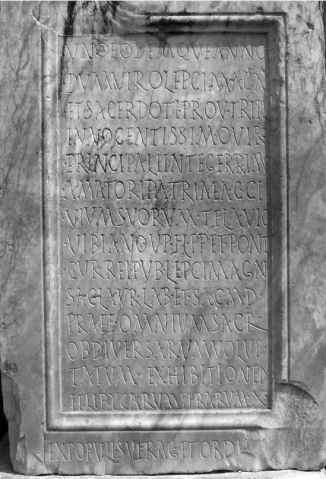
Base for statue of Titus Flavius Vibianus Heraclius, priest and curator. Lepcis Magna (Tripolitania). Earlier fourth century.
Record details
Photographs
Inscription
?[Heraclii]. / Uno eodemque anno / du(u)mviro Lepcimagn(ensium) / et sacerdoti prov(inciae) Trip(o)l(itanae), innocentissimo viro, /(5) principali integerrimo, / amatori patriae ac ci/vium suorum, T(ito) Flavio / Vibiano v(iro) p(erfectissimo), fl(amini) p(er)p(etuo) et pont(ifici), / cur(atori) rei pub(licae) Lepcimagn(ensium), /(10) sac(erdoti) Laur(entium) Lab(inatium) et sac(erdoti) M(atris) d(eum), / praef(ecto) omnium sacr(orum), / ob diversarum volup/tatum exhibitionem / et Libycarum ferarum X, /(15) ex populi sufrag(io) et ordin[(is) d(ecreto)]
Inscription translation
Statue of Heraclius. In the same year duovir of Lepcis Magna and priest of the province of Tripolitania, a most blameless man, a most honest principalis, a lover of his fatherland and of his fellow-citizens, Titus Flavius Vibianus, of perfectissimus rank, perpetual flamen and pontifex, curator of the community (res publica) of Lepcis Magna, priest of the Laurentes Lavinates, priest of the Mother of the gods, prefect of all sacred things. On account of the display of various delights and of ten Libyan beasts, by acclamation of the people and by decree of the council (ordo [this was set up].
Bibliography
- Reynolds, J. M. & J. B. Ward-Perkins, The Inscriptions of Roman Tripolitania. In collaboration with S. Aurigemma, R. Bartoccini, G. Caputo, R. Goodchild, P. Romanelli, Roma 1952, no. 567
- Tantillo, I. and F. Bigi (eds.), Leptis Magna. Una città e le sue iscrizioni in epoca tardoromana, Cassino 2010, 422-5, no.56, figs. 7.23, 10.64, pl. 18
Discussion
INSCRIPTION
Preserved in 15 lines which were probably preceded by a signum, now lost:
?[Heraclii]. / Uno eodemque anno / du(u)mviro Lepcimagn(ensium) / et sacerdoti prov(inciae) Trip(o)l(itanae), innocentissimo viro, /(5) principali integerrimo, / amatori patriae ac ci/vium suorum, T(ito) Flavio / Vibiano v(iro) p(erfectissimo), fl(amini) p(er)p(etuo) et pont(ifici), / cur(atori) rei pub(licae) Lepcimagn(ensium), /(10) sac(erdoti) Laur(entium) Lab(inatium) et sac(erdoti) M(atris) d(eum), / praef(ecto) omnium sacr(orum), / ob diversarum volup/tatum exhibitionem / et Libycarum ferarum X, /(15) ex populi sufrag(io) et ordin[(is) d(ecreto)].
'Statue of Heraclius. In the same year duovir of Lepcis Magna and priest of the province of Tripolitania, a most blameless man, a most honest principalis, a lover of his fatherland and of his fellow-citizens, Titus Flavius Vibianus, of perfectissimus rank, perpetual flamen and pontifex, curator of the community (res publica) of Lepcis Magna, priest of the Laurentes Lavinates, priest of the Mother of the gods, prefect of all sacred things. On account of the display of various delights and of ten Libyan beasts, by acclamation of the people and by decree of the council (ordo [this was set up].'
Letter height 4 cm.
DESCRIPTION
Shaft and lower mouldings of a Pentelic marble base; H 128, W 88, D 90 cm. The mouldings are worked separately, the upper one is lost. The epigraphic field is surrounded by a moulded frame; the last line is carved below the frame.
Our inscription is the second use of the base. Traces of an erased earlier inscription are visible on the right side; that this earlier text is on a lateral face is explicable by the fact that the shaft is worked separately and could easily be turned. The formal properties of the mouldings suggest a date for the original use in the late 2nd/ early 3rd century.
Photos from the time of excavation show a headless togate statue lying next to the base (LSA-2609).
PROVENANCE AND CURRENT LOCATION
The base is standing in the eastern colonnade of the Severan forum (Tantillo & Bigi 2010 map I). Like other statues in this colonnade (LSA-2149, LSA-2178, LSA-2191, LSA-2200, LSA-2204), it is standing on the original pavement and therefore in its original location.
HONORAND, AWARDER AND DATE
Titus Flavius Vibianus, the honorand, was a member of the established local family of the Flavii Heraclii and probably a brother of Titus Flavius Frontinus signo Heraclius (LSA-2200) and uncle of Titus Flavius Vibianus iunior signo Heraclius (LSA-2201). The inscription was set up on the occasion of his duovirate which he held at the same time as the provincial priesthood of Tripolitania (lines 3-4) and which he celebrated with lavish spectacles (lines 12-14). The inscription records ten ‘Lybian beasts’ (line 14) which were probably big cats. This would have been an extraordinarily lavish display; Vibianus was possibly involved in the lucrative animal trade in Lepcis Magna (see also LSA-2196, LSA-2197 and LSA-2203).
The inscription was set up by the civic bodies of Lepcis Magna (ordo and populus, line 15) which are recorded with an epigraphic formula similar to the contemporary dedications to Frontinus and Vibianus iunior (LSA-2200, LSA-2201; see also LSA-2203).
The provincial priesthood recorded by our inscription provides a secure terminus post quem of 303, the year in which the province was founded. A bundle of considerations suggests a date for our inscription in the earlier 4th century, most probably in the Constantinian period (for a detailed discussion, see LSA-2200).
FURTHER DISCUSSION
Our inscription provides a rare example of a municipal cursus honorum and the most complete known from the African provinces in our period (see also the almost identical inscription to the same honorand LSA-2203, and the approximately contemporary ones to Marcus Vibius Annianus Geminus Amelius LSA-2204 and LSA-2205).
Cite: Last Statues of Antiquity, LSA-2202 (Ignazio Tantillo & Francesca Bigi).