
LSA-2203
Base for statue of Titus Flavius Vibianus Heraclius, priest. Lepcis Magna (Tripolitania). Earlier fourth century.
Record details
Photographs
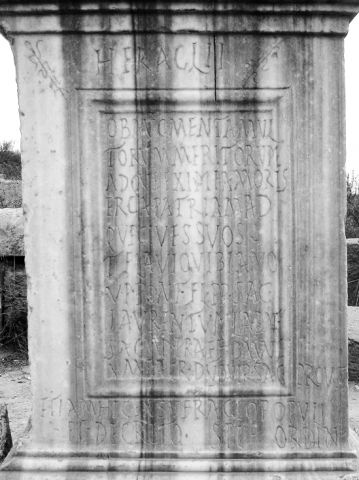
Inscription
Heraclii. / Ob augmenta mul/torum meritorum, / adque eximi(i) amoris /(5) erga patriam ad/que cives suos, / T(ito) Flavio Vibiano / v(iro) p(erfectissimo), pont(ifici), fl(amini) p(er)p(etuo), sac(erdoti) / Laurent(i)um Lab(i)n(a)t(ium), /(10) sac(erdoti) M(atris) d(eum), praef(ecto) omni/um sacr(orum), duovir(o), sac(erdoti) prov(inciae) Tr(ipolitanae), / etiam hic ex sufragio populi / et decreto spl(endidissimi) ordin(is).
Inscription translation
(Statue of) Heraclius. On account of the increase of his many merits and his outstanding love for the fatherland and his fellow citizens; to Titus Flavius Vibianus, of perfectissimus rank, priest (pontifex), perpetual flamen, priest of Laurentes Lavinates, priest of the Mother of the gods, prefect of all sacred things, duovir, priest of the province of Tripolitania. Here too [this was set up] by acclamation of the people and by decree of the most splendid council (ordo).
Bibliography
- Reynolds, J. M. & J. B. Ward-Perkins, The Inscriptions of Roman Tripolitania. In collaboration with S. Aurigemma, R. Bartoccini, G. Caputo, R. Goodchild, P. Romanelli, Roma 1952, no.568
- Tantillo, I. and F. Bigi (eds.), Leptis Magna. Una città e le sue iscrizioni in epoca tardoromana, Cassino 2010, 425--7, no.57, figs. 7.19, 10.65, pl. 24
Discussion
INSCRIPTION
In 13 lines:
Heraclii. / Ob augmenta mul/torum meritorum, / adque eximi(i) amoris /(5) erga patriam ad/que cives suos, / T(ito) Flavio Vibiano / v(iro) p(erfectissimo), pont(ifici), fl(amini) p(er)p(etuo), sac(erdoti) / Laurent(i)um Lab(i)n(a)t(ium), /(10) sac(erdoti) M(atris) d(eum), praef(ecto) omni/um sacr(orum), duovir(o), sac(erdoti) prov(inciae) Tr(ipolitanae), / etiam hic ex sufragio populi / et decreto spl(endidissimi) ordin(is).
'(Statue of) Heraclius. On account of the increase of his many merits and his outstanding love for the fatherland and his fellow citizens; to Titus Flavius Vibianus, of perfectissimus rank, priest (pontifex), perpetual flamen, priest of the Laurentes Lavinates, priest of the Mother of the gods, prefect of all sacred things, duovir, priest of the province of Tripolitania. Here too [this was set up] by acclamation of the people and by decree of the most splendid council (ordo).'
Letter height 4 - 5.5 cm.
DESCRIPTION
Monolithic base of Proconnesian marble, with mouldings at top and bottom; H 152, W 92, D 95 cm. The front and lateral faces are decorated with a moulded frame; the back face is finished with a point. The upper face has a series of point marks, but no dowel or clamp holes; this is an indicator that on top there was a marble plinth without fixings. That the base was crowned with a marble statue is also suggested by photos from the period of the excavations, when a headless togate statue was found lying next to the base. On the right side of the base, there is a vertical line of scratches along which are sited three rectangular holes - traces of a later attempt to break up the block.
Our inscription is the second use of the base. The original inscription, partly erased, is still visible on the right side of ours (which was the original front; IRT 630); it is one of a series of three homogeneous municipal dedications of the 2nd century (IRT 628-30).
PROVENANCE AND CURRENT LOCATION
The inscription was found in the macellum, at its main entrance from the cardo (Tantillo & Bigi 2010 map II), a highly unusual placing for honorific inscriptions in Lepcis Magna, and photos from the period of excavation show that at that time our inscription faced the cardo - its present orientation, with the earlier inscription IRT 630 facing the cardo, is the result of a later arrangement. The entrance to the macellum was extensively restored under the governor Laenatius Romulus in 324/6; the position of our base, framed by the entrance and with the inscription facing the main street, suggests a close relationship between the honorand and the building (see also below, ‘Honorand, Awarder and Date’).
HONORAND, AWARDER AND DATE
Titus Flavius Vibianus signo Heraclius, the honorand, was a member of the established local family of the Flavii Heraclii, and probably a brother of Titus Flavius Frontinus signo Heraclius (LSA-2200) and uncle of Titus Flavius Vibianus iunior signo Heraclius (LSA-2201). Remarkably the inscription does not record any specific benefactions, just priestly offices and generic love towards his city. This can possibly be explained from the unusual context of the base (see above, ‘Provenance and Current Location’). Vibianus was a noble benefactor and probably involved in the lucrative animal trade in Lepcis (see also LSA-2202); he was perhaps involved with the restoration of the macellum where the animal trade took place. Titus Flavius Vibianus Heraclius was honoured with a further statue on the Severan forum (LSA-2202).
Our inscription was set up by the civic bodies of Lepcis Magna (the ordo and populus, lines 12-13), which are recorded with an epigraphic formula similar to that on the contemporary dedications to Frontinus and Vibianus iunior (LSA-2200, LSA-2201; see also LSA-2202).
The provincial priesthood recorded in our inscription (line 11) provides a secure terminus post quem of 303, the year in which the province of Tripolitania was established. However, a number of elements suggest a date in the Constantinian period (see the detailed account in LSA-2200).
Cite: Last Statues of Antiquity, LSA-2203 (Ignazio Tantillo & Francesca Bigi).