
LSA-2208
Base for statue of unknown honorand, probably imperial official and patron of Lepcis Magna. Lepcis Magna (Tripolitania). Fourth century.
Record details
Photographs
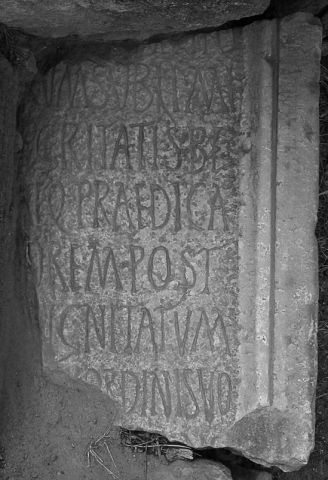
Inscription
- - - - - - / [- - -] merito / [- - -]rum sublimi / [- - - inte]gritatis be/(4)[- - -]aeq(ue) praedica-/[bil- - - -]orem post / [- - - d]ignitatum / [- - -e]x ordinis vo/[- - - patro]no / - - - - - -
Inscription translation
To … merit…sublime…of integrity … praiseworthy … dignities…of the ordo…to the patron…
Bibliography
- Reynolds, J. M. & J. B. Ward-Perkins, The Inscriptions of Roman Tripolitania. In collaboration with S. Aurigemma, R. Bartoccini, G. Caputo, R. Goodchild, P. Romanelli, Roma 1952, no. 651
- Tantillo, I. and F. Bigi (eds.), Leptis Magna. Una città e le sue iscrizioni in epoca tardoromana, Cassino 2010, 438-440, no. 63, fig. 10.72
Discussion
INSCRIPTION
Fragmentarily preserved in eight lines:
- - - - - - / [- - -] merito / [- - -]rum sublimi / [- - - inte]gritatis be/(4)[- - -]aeq(ue) praedica-/[bil- - - -]orem post / [- - - d]ignitatum / [- - -e]x ordinis vo/[- - - patro]no / - - - - - -
'To … merit…sublime…of integrity…praiseworthy…dignities…of the ordo…to the patron…'.
Letter height 5 cm.
DESCRIPTION
Fragment of a Proconnesian marble base, H 45, W 30, D 18 cm. An inscribed face is preserved with its centre and right margin. The epigraphic field is surrounded by a moulded frame.
Our inscription is carved over an erased earlier one, traces of which are scattered on the frame and on the epigraphic field. The epigraphic field bears numerous tool marks from a point.
In the Byzantine period, the base was reused as building material (see below, ‘Provenance and Current Location’).
The possibility to combine this fragment with an inscription to an unknown vicar (LSA-2171), similar in material and letter form, was rejected because there are slight differences in the moulded frame.
PROVENANCE AND CURRENT LOCATION
The inscription was found built into the steps of the southern apse of the Severan basilica, where it was inserted in the Byzantine period when the basilica was transformed into a church. There it is still there.
HONORAND, AWARDER AND DATE
The wording in lines 2-5 contains elements from the vocabulary used for eulogies to imperial office holders ( sublimi … integritatis … praedicabili). - dignitatum (line 6) alludes to the high offices in the imperial service held by the honorand; he was a high-ranking imperial office holder, a provincial governor, vicar, or praetorian prefect. The extant letters of line 8, suggest that the honorand was a patron of Lepcis Magna.
The letter form suggests a date in the Constantinian period; however, in the absence of better dating criteria, we propose broad outer dates in the 4th century.
The inscription was set up by civic bodies of Lepcis Magna (line 7). However, the formula is unusual; normally the substantive which depends on the preposition ex would precede the genitive ordinis.
Cite: Last Statues of Antiquity, LSA-2208 (Ignazio Tantillo & Francesca Bigi).