
LSA-221
Fragmentary base for 'friend of the emperors'. Aphrodisias (Caria). Earlier fourth century.
Record details
Photographs
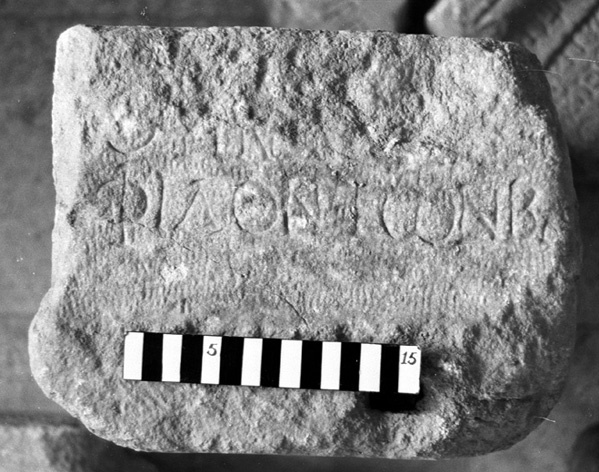
Inscription
[...]ομνv.οι ιιιι[...] / [...]φίλον τῶν βα[σιλέων][...]
Inscription translation
... friend of the emperors ... .
(Trans: C. Roueché)
Bibliography
- Roueché, C., Aphrodisias in Late Antiquity (Journal of Roman Studies Monograph 5), London 1989, no. 15
Discussion
INSCRIPTION
Two lines partly preserved:
[...]ομνv.οι ιιιι[...] / [...]φίλον τῶν βα[σιλέων][...]
'... friend of the emperors ...'. (Trans: C. Roueché)
Letter height 2.5 - 4 cm.
DESCRIPTION (Object)
Fragment of base preserving traces of two lines. 35 x 22 x 42 cm. White marble.
The upper portion and lower edges are worked smoothly. The block was probably cut-down for re-use or, as suggested by Roueché, part of a larger monument . Photographs show that the front surface has a heavily claw-chiselled finish.
PROVENANCE AND CURRENT LOCATION
It was excavated in 1968 (exc. inv. 68-401) in the Theatre, over the northern part of the orchestra. This was an area of a significant amount of fill and later walls.
DATE
The inscription honours a friend of the emperors just as LSA-187 which belongs to the earlier fourth century. The lettering suggests a similar date.
Cite: Last Statues of Antiquity, LSA-221 (J. Lenaghan).