
LSA-2210
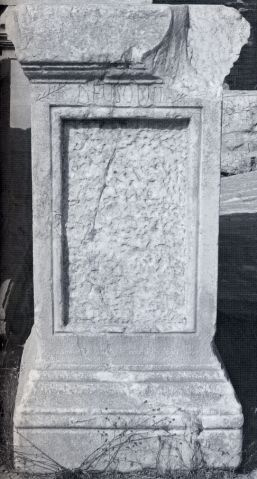
Base for statue of Deusonius. Lepcis Magna (Tripolitania). Fourth century.
Record details
Photographs
Inscription
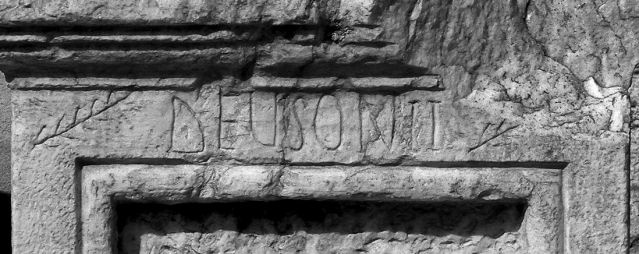
Deusonii / - - - - - - -
Inscription translation
(Statue of) Deusonius. …
Bibliography
- Reynolds, J. M. & J. B. Ward-Perkins, The Inscriptions of Roman Tripolitania. In collaboration with S. Aurigemma, R. Bartoccini, G. Caputo, R. Goodchild, P. Romanelli, Roma 1952, no. 691
- Tantillo, I. and F. Bigi (eds.), Leptis Magna. Una città e le sue iscrizioni in epoca tardoromana, Cassino 2010, 440-441, no. 65, figs. 7.14, 10.74, pl. XIX
Discussion
INSCRIPTION
One line preserved:
Deusonii / - - - - - - -
'(Statue of) Deusonius. …'.
Letter height 5 cm.
DESCRIPTION
Monolithic base of Pentelic marble moulded at top and bottom; H 150, W 75, D 70 cm. The front right and both rear corners are broken. The front face is decorated with a moulded frame; both lateral faces are finished with a claw and without frame; the back face is finished with a point. On the top face there are shallow cavities for the feet of a bronze statue, one at the front right, the other one at the left margin. Both are furnished with dowel holes; three further rectangular holes at the back margin were probably additional supports for that statue.
The front face shows traces of at least two, possibly three phases of epigraphic use. The moulded frame was secondarily worked back and the framed field was considerably lowered with a point. This irregular surface is very unlikely to have been inscribed and it is probable that a plaque was inserted. Such a use of an additional plaque was normally necessary if more than one inscription had been carved and erased in the same epigraphic field (Tantillo & Bigi 2010 ch. 7.2.4). The inscription on the plaque would therefore be from the last phase of use. The signum is carved above the frame and shows no trace of erasure; it therefore also belonged to the final phase of epigraphic use. The shape of the mouldings suggests that the first use of the base can be dated to the early 3rd century (see Tantillo and Bigi 2010, 237).
PROVENANCE AND CURRENT LOCATION
The base was found in the eastern colonnade of the Severan forum, adjacent to the equestrian statue base LSA-2149. This was probably not the original location; it is possible, however, that it was set up in the eastern colonnade, in front of a column, as is the case with the bases still in situ in that colonnade (LSA-2149, LSA-2178, LSA-2191, LSA-2178, LSA-2200, LSA-2202, LSA-2204).
The base is now standing in the eastern colonnade of the Severan forum, in front of the apse linking with the Severan basilica (Tantillo & Bigi 2010 map I).
HONORAND AND DATE
Only the signum is preserved of the honorand’s name. The termination in -ii (instead of -i) indicates a date in the 4th century, after Diocletion (Tantillo & Bigi 2010 ch. 5.10). The letter form is compatible with inscriptions from the later 4th century (LSA-2155, LSA-2156).
Cite: Last Statues of Antiquity, LSA-2210 (Ignazio Tantillo & Francesca Bigi).