
LSA-2211
Base with multiple signa, re-used for LSA-2176. Lepcis Magna (Tripolitania). Later third century.
Record details
Photographs
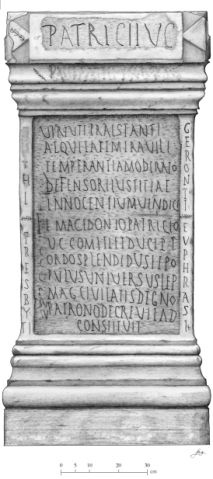
Inscription
upper moulding
[[[…]]] / P[[[…]]]
vertically down proper right side
[…]thi Presbyti
vertically down proper left side
Geronti / Euphrasi
Inscription translation
... P... ...thius ... presbeutes Gerontius Euphrasius
Bibliography
- Reynolds, J. M. & J. B. Ward-Perkins, The Inscriptions of Roman Tripolitania. In collaboration with S. Aurigemma, R. Bartoccini, G. Caputo, R. Goodchild, P. Romanelli, Roma 1952, no. 694
- Tantillo, I. and F. Bigi (eds.), Leptis Magna. Una città e le sue iscrizioni in epoca tardoromana, Cassino 2010, 441-2, no. 66, figs. 7.14, 10.35, pl. X
Discussion
INSCRIPTION
Fragmentarily preserved in one line on the upper moulding and in four words carved vertically on the left and right frame:
upper moulding
[[[…]]] / P[[[…]]]
vertically down proper right side
[…]thi Presbyti
vertically down proper left side
Geronti / Euphrasi
... P... ...thius ... presbeutes Gerontius Euphrasius
Letter height 3-4 cm.
DESCRIPTION
Monolithic base of Proconnesian marble, with mouldings at top and bottom; H 150, W 71, D 84 cm. The lateral faces are decorated with a concentric moulded frame. On the front face this frame has been worked back in order to enlarge the epigraphic field; moreover, the uppermost of the top mouldings has been worked back for the insertion of a tabula ansata that carried the signum of the honorand.
Our inscription is the first or second re-use of the base; it was later erased for the inscription LSA-2176. Our inscription already makes use of the extended epigraphic field on the front face that was later used for LSA-2176 and therefore cannot be the original inscription. Another inscription from a reuse, now erased, is visible on the right side. The original inscription was carved on the front face with the original decoration intact. This first use was most probably in the Severan era when the base was produced.
Of our inscription, numerous traces of letters are visible in the inner part of the epigraphic field. Furthermore, four signa carved vertically on the left and right margins must be attributed to this phase. On the top moulding, a letter from a line that was framed by palm twigs is still visible (P or D); on the uppermost moulding, the signum of LSA-2176 (the fourth and last epigraphic use of the base) is carved over an erased earlier one, probably from our inscription.
PROVENANCE AND CURRENT LOCATION
The inscription was first recorded in 1953 on the Severan forum, on the eastern part of the piazza. There it is still standing (Tantillo & Bigi 2010 map I).
HONORAND, AWARDER AND DATE
The name of the honorand is lost. The erased text in the tabula ansata on the top moulding was probably his signum, while the subsequent line on the top moulding possibly specified his rank or office.
The four signa on the lateral margins of the front face are unique in the honorific epigraphy of Lepcis Magna. Given the fact that the base supported just one statue, the most probable solution for this is that the signa represent four individuals that awarded the statue, most probably local notables. Their names, like the honorand’s were probably recorded in the main text.
A secure terminus ante quem is given by the inscription to Patricius LSA-2176 in the late 4th century. The use of signa in our inscription suggests a date not earlier than the mid-3rd century; their ending in simple -i (instead of double -ii) suggests a date not later than the period of Diocletian (284-305; on the form of the signa in Lepcis Magna see Tantillo & Bigi 2010 ch. 5.10).
Cite: Last Statues of Antiquity, LSA-2211 (Ignazio Tantillo & Francesca Bigi).