
LSA-2213
Base for statue of Constantine I, emperor. Lepcis Magna (Tripolitania). 324-326.
Record details
Photographs
Inscription
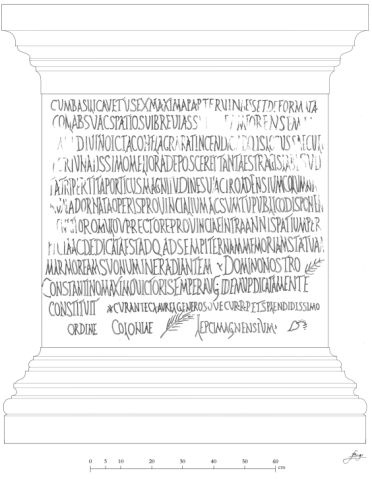
Cum basilica vetus ex maxima parte ruina esset deformata / conlabsu ac spatio sui breviass[et ar]eam forensem ++ / [.?]++++ divino icta conflagrarat incendio adq(ue) is locus saecul[o] /(4) fortunatissimo meliora deposceret tantae stragis labe subl[a]/ta tripertita porticus magnitudine sui ac Troadensium columna/rum adornata operis provincialium ac sum(p)tu publico disponen(te) / [La]enatio Romulo v(iro) p(erfectissimo) rectore provinciae intra anni spatium per/fecta ac dedicata est adq(ue) ad sempiternam memoriam statuam / marmoream suo numine radiantem domino nostro /(10) Constantino maximo victori semper Aug(usto) idem v(ir) p(erfectissimus) dicata mente / constituit (vac. c.4) curante Cl(audio) Aurel(io) Generoso v(iro) e(gregio) cur(atore) r(ei) p(ublicae) et splendidissimo / ordine coloniae Lepcimagnensium.
Inscription translation
When the old basilica was mainly in ruin, deformed by collapse, so that it curtailed the area of the forum, and struck by divine... it burned in a fire, and when the place in a more fortunate era demanded better, the blemish of the debris was taken away, and a tripartite portico decorated by its own magnitude and by columns from Troas, from provincial labour and public expense made available by Laenatius Romulus, of perfectissimus rank, governor of the province, was completed and dedicated in the space of one year. And, as eternal memory, the same man of perfectissimus rank, with devoted spirit, set up a marble statue that was radiant by his divine spirit to our lord Constantine, most powerful victor, eternal Augustus. (The work was) overseen by Claudius Aurelius Generosus, of egregius rank, curator of the republic and of the most splendid ordo of the colony of Leptis Magna.
Bibliography
- Reynolds, J. M. & J. B. Ward-Perkins, The Inscriptions of Roman Tripolitania. In collaboration with S. Aurigemma, R. Bartoccini, G. Caputo, R. Goodchild, P. Romanelli, Roma 1952, no. 467
- Tantillo, I. 'Riflessioni su Costantino e il sole', Mélanges de l'Ecole française de Rome. Antiquité. 115.2
, Rome 2003, 986-996, fig. 1 - Tantillo, I. and F. Bigi (eds.), Leptis Magna. Una città e le sue iscrizioni in epoca tardoromana, Cassino 2010, 451-6, no. 71, figs. 8.6, 10.81, pl. XX
Discussion
INSCRIPTION
In 12 lines:
Cum basilica vetus ex maxima parte ruina esset deformata / conlabsu ac spatio sui breviass[et ar]eam forensem ++ / [.?]++++ divino icta conflagrarat incendio adq(ue) is locus saecul[o] /(4) fortunatissimo meliora deposceret tantae stragis labe subl[a]/ta tripertita porticus magnitudine sui ac Troadensium columna/rum adornata operis provincialium ac sum(p)tu publico disponen(te) / [La]enatio Romulo v(iro) p(erfectissimo) rectore provinciae intra anni spatium per/fecta ac dedicata est adq(ue) ad sempiternam memoriam statuam / marmoream suo numine radiantem domino nostro /(10) Constantino maximo victori semper Aug(usto) idem v(ir) p(erfectissimus) dicata mente / constituit (vac. c.4) curante Cl(audio) Aurel(io) Generoso v(iro) e(gregio) cur(atore) r(ei) p(ublicae) et splendidissimo / ordine coloniae Lepcimagnensium.
'When the old basilica was mainly in ruin, deformed by collapse, so that it curtailed the area of the forum, and struck by divine... it burned in a fire, and when the place in a more fortunate era demanded better, the blemish of the debris was taken away, and a tripartite portico decorated by its own magnitude and by columns from Troas, from provincial labour and public expense made available by Laenatius Romulus, of perfectissimus rank, governor of the province, was completed and dedicated in the space of one year. And, as eternal memory, the same man of perfectissimus rank, with devoted spirit, set up a marble statue that was radiant by his divine spirit to our lord Constantine, most powerful victor, eternal Augustus. (The work was) overseen by Claudius Aurelius Generosus, of egregius rank, curator of the republic and of the most splendid ordo of the colony of Leptis Magna.'
Letter height 3-5 cm.
DESCRIPTON
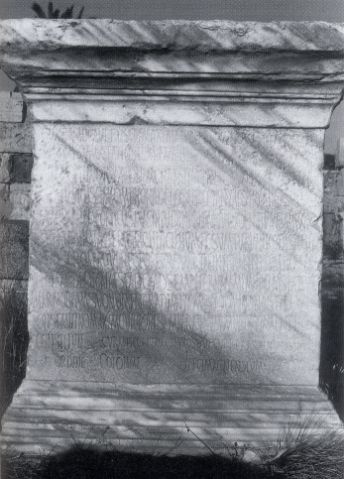
Monolithic base of proconnesian marble, moulded at top and bottom; H 146, W 119, D 119 cm. The block is from the group of architectural elements of the Severan period that were never applied as building material and were later used as statue supports. The dimensions and the formal properties are similar to the large pedestals from the Severan nymphaeum. Like those, our base is finished on three sides whereas the back face is left in an intermediate state, with the mouldings just sketched out and the shaft finished with a point. The top face is also finished with a point and has no dowel holes for the fixing of a statue; however, the inscription makes explicit that a marble statue was standing on top (lines 8.9).
Our inscription is the first epigraphic use of the base.
PROVENANCE AND CURRENT LOCATION
The inscription was first recorded on the western side of the Old forum in 1953, standing loose in the trajanic building that was transformed into a church in the byzantine period (Ward-Perkins & Goodchild 1953, 24-9). The inscription that is mainly concerned with the building work on the tripertita porticus of the Old forum makes it appear likely that the original location of the inscription was a preeminent position in this colonnade, and that it was brought to the church later, perhaps to serve as an ambo (Tantillo 2003, 989-91).
The base is still standing where it was first recorded.
HONORAND, AWARDER AND DATE
Constantine I, the honorand (lines 9-10) was Augustus 306-37.
The inscription was set up by Laenatius Romulus, governor (praeses) of the province of Tripolitania in 324/6. He was himself awarded two statues at Lepcis Magna (LSA-2179; LSA-2180), and with another one in Sabratha (Tantillo & Bigi 2010 no. 95). His name is recorded on a building inscription from the macellum that contains imperial names which date Romulus’ time in office securely to the years 324/6 (Tantillo and Bigi 2010 no. 72). Another statue base with a similar if only fragmentarily preserved inscription was probably also set up by him (LSA-2214); moreover, he is probably the governor alluded to by the mutilated inscription LSA-2205.
Claudius Aurelius Generosus, curator of the city, took charge for the erection of the statue, together with the city council of Lepcis Magna (lines 11-13). Generosus is otherwise not known; his name is unheard of in Lepcis Magna and he was probably a foreigner. His rank predicate of egregius probably provides a terminus ante quem for the inscription; it appears to have been abandoned in the wake of the reform of the ordo equester in 326.
Cite: Last Statues of Antiquity, LSA-2213 (Ignazio Tantillo & Francesca Bigi).