
LSA-2216
Base for statue of the 'Genius of the Colony'. Lepcis Magna (Tripolitania). Mid-fourth century.
Record details
Photographs
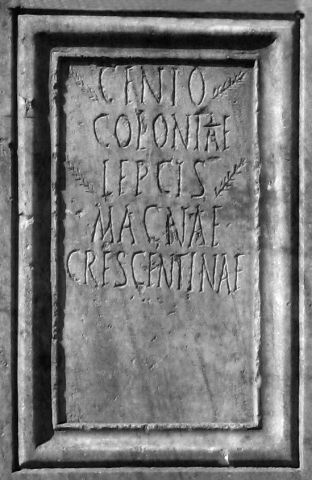

Inscription
Λέπκις ἡ Μεγάλη φιλ(ε)ῖ σε Ῥώμη / Genio /
Coloniae / Lepcis /(5) Magnae / Crescentina f(ecit?).
Inscription translation
Leptis Magna loves you, Roma. Crescentina (set this up) for the Genius of the Colony of Lepcis Magna.
Bibliography
- Reynolds, J. M. & J. B. Ward-Perkins, The Inscriptions of Roman Tripolitania. In collaboration with S. Aurigemma, R. Bartoccini, G. Caputo, R. Goodchild, P. Romanelli, Roma 1952, no. 282
- Tantillo, I. and F. Bigi (eds.), Leptis Magna. Una città e le sue iscrizioni in epoca tardoromana, Cassino 2010, 475-7, no. 84, figs. 7.16, 10.99, 10.100, pl. XII
Discussion
INSCRIPTION
In six lines, one in Greek and five in Latin:
Λέπκις ἡ Μεγάλη φιλ(ε)ῖ σε Ῥώμη / Genio / Coloniae / Lepcis /(5) Magnae / Crescentina f(ecit?).
Leptis Magna loves you, Roma. To the Genius of the colony of Lepcis Magna, Crescentina set this up.
Letter height 5 cm.
In line 6 we prefer to read Crescentina fecit as first suggested by Degrassi 1954, 115, over Crescentinae as proposed by Reynolds (see below, ‘Honorand, Awarder and Date’).
DESCRIPTION
Monolithic base of Proconnesian marble, moulded at top and bottom; H 155, W 90, D 90 cm. All faces are decorated with a moulded frame; on the right side a lituus and on the left side an <urceus are standing proud. On the face opposite to our inscription (the original front face), the inscription to the curator Lucius Volusius Bassus Cerealis of the tetrarchic period is carved. Our inscription is the second reuse of the base; the earlier inscription (LSA-2197) is already carved over an erased earlier one. On the top face there are two pairs of cavities for the fixing of a bronze statue, both at the original front edge and both facing towards the original front. Two circular dowel holes belong to one of these statues; a third, rectangular hole is placed in the centre of the top. At both lateral margins there are rectangular holes, almost certainly clamp holes for the fixing of a marble statue plinth. The two bronze statues must be attributed to the two sucessive inscriptions on the original front, while our inscription was for a marble statue.
The formal properties and dimensions of our base are very similar to LSA-2180, a reused base originally from the 2nd century; our base was possibly produced as a twin to that one.
PROVENANCE AND CURRENT LOCATION
The base is standing where it was found, in front of the stairs of the temple on the western side of the Severan forum (Tantillo & Bigi 2010 map I). This is not its original position, because when found the base was standing on debris lying over undressed pavement. It is likely that it was set up along with the two other dedications to the Genius of the colony (LSA-2215; Tantillo & Bigi 2010 no. 83) in the south western part of the forum (Tantillo & Bigi 2010 map I). When the base was used earlier (in the tetrarchic period) for the inscription to Cerealis, it must have been set up in a different part of the forum (LSA-2197).
HONORAND, AWARDER AND DATE
The inscription is dedicated to the Genius of the colony (lines 2-3; Tantillo & Bigi 2010 ch. 1.2.3).
The interpretation of line 6 provides some difficulties (see above, ‘Inscription’). Reynolds suggested reading another title of the colony; however this is otherwise unattested, and one would expect it to appear in front of the toponym (colonia Crescentina Lepcis Magna). Moreover, the provenance of such a title would be hard to explain; it cannot be derived from an imperial name, and it is hard to imagine that the title of a colony could be derived from the name of a private individual. We therefore followed a suggestion by Degrassi 1954, to recognize the name of the awarder in line 6. Though this solution also has its problems, it has the advantage of adding an awarder to the inscription. Crescentina was possibly a member of one of the established families of Lepcis Magna, linked to traditional values.
The terminus post quem for our inscription is the earlier dedication to Lucius Volusius Bassus Cerealis from the tetrarchic period on the opposite face (LSA-2197). Most probably it dates about one generation later than that earlier inscription, to the earlier 4th century. It is certainly the latest dedication to a Genius in Lepcis Magna (LSA-2215 and Tantillo & Bigi 2010 no. 83 date to the mid/ late 3rd century; a further unpublished inscription from the late antique baths is datable to around 250).
Cite: Last Statues of Antiquity, LSA-2216 (Ignazio Tantillo & Francesca Bigi).