
LSA-2217
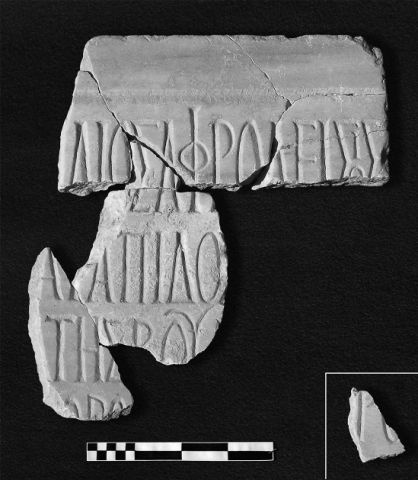
Plaque recording possible statue dedication by Aurelius Aphrodisius. Lepcis Magna (Tripolitania). Third to fourth century.
Record details
Photographs
Inscription
[---]+ΙΟΣ (ivy leaf) ΑΦΡΟ+ΕΙΣΙΟΣ / [---]Α+ΑΠΙΔΟΣ[- 6? -] / [---]ΤΗΣ+ΟΥ+[- 6? -] / [---]Ο+Ο[- 9? -] / ------
[---? Αὐρη]λιος (ivy leaf) Ἀφροδείσιος / [--- Σ]αράπιδος [- 6? -] / [---] τῆς βουλ[ῆς – 4? -] / [---]Ο+Ο[- 9? -]
Inscription translation
... Aurelius Aphrodisius, ... of Serapis (?), ... of the council ..
Bibliography
- Tantillo, I. and F. Bigi (eds.), Leptis Magna. Una città e le sue iscrizioni in epoca tardoromana, Cassino 2010, 477-8, no. 85, fig. 10.101
Discussion
INSCRIPTION
Fragmentarily preserved in four lines; a further fragment is not placeable:
[---]+ΙΟΣ (ivy leaf) ΑΦΡΟ+ΕΙΣΙΟΣ / [---]Α+ΑΠΙΔΟΣ[- 6? -] / [---]ΤΗΣ+ΟΥ+[- 6? -] / [---]Ο+Ο[- 9? -] / ------
[---? Αὐρη]λιος (ivy leaf) Ἀφροδείσιος / [--- Σ]αράπιδος [- 6? -] / [---] τῆς βουλ[ῆς – 4? -] / [---]Ο+Ο[- 9? -]
'... Aurelius Aphrodisius, ... of Serapis (?), ... of the council ...'.
Fragment, not placeable:
------ / [---]ΡΟ[---] / ------
Letter height not recorded.
DESCRIPTION
Seven adjacent fragments of a Proconnesian marble plaque; H 41.8, W 39.2, D3.2 cm. The recomposed fragments preserve a portion of the upper margin of the epigraphic field, and portions from the centre of the first three lines of the inscription, plus a tiny bit of line 4. A further fragment containing the letters ΡΟ is securely part of the same inscription but cannot be set in place.
PROVENANCE AND CURRENT LOCATION
One fragment containing the largest portion of line 2 and small portions of lines 1 and 3 (= Inscriptions of Roman Tripolitania (IRT) 311, http://inslib.kcl.ac.uk/irt2009/IRT311.html) was found in the area of the Punic market of Lepcis during works clearing the road to the west of it, according to IRT; this is probably the street leading from the theatre to the sea shore, passing the temple of Serapis. The other fragments were found in the temple of Serapis.
The marble plaque with the inscription was probably applied to a support in different material.
The inscription is now stored in the Lepcis museum (without published inv. no.).
HONORAND, AWARDER AND DATE
The inscription apparently commemorates something the person recorded in line 1 gave or executed in connection with the cult of Sarapis, and by order or permission of the city council (boule). This was possibly a votive or cult statue. One of his names, Aphrodisius, is preserved; this is a common name in Egypt, from where almost all persons recorded in the inscriptions from the Serapeion came.
The letter forms suggest a date in the 3rd or 4th century for our inscription.
FURTHER DISCUSSION
The record of the city council (boule) probably points to a formal authorisation for the act commemorated in the inscription; this is interesting because it shows that the civic institutions of Lepcis had control over the activities of the temple.
Cite: Last Statues of Antiquity, LSA-2217 (Ignazio Tantillo & Francesca Bigi (discussion added 9/14)).