
LSA-222
Fragmentary base for statue of Helladius, governor. Aphrodisias (Caria). Earlier fourth century.
Record details
Photographs
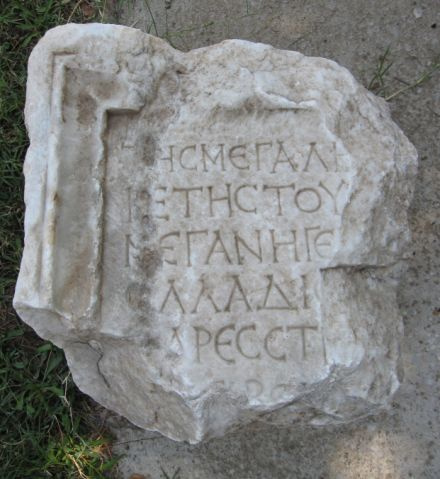
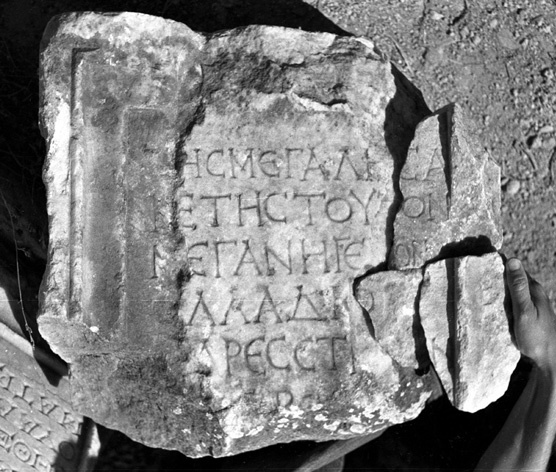
Inscription
τῆς μεγάλης ἀ/ρετῆς τοῦτον / μέγαν ἡγεμονῆα / vac. Ἑλλάδιον vac. / [Κ]ᾶρες στῆ[σα]ν | [ἀ]μειβόμ[ενο]ι.
Inscription translation
The Carians set up (a statue of) this great governor, Helladius, making a return for his great virtue.
(Trans: C. Roueché)
Bibliography
- Roueché, C., Aphrodisias in Late Antiquity (Journal of Roman Studies Monograph 5), London 1989, no. 16
Discussion
INSCRIPTION
Verse inscription of one elegiac distich laid out in six lines:
τῆς μεγάλης ἀ/ρετῆς τοῦτον / μέγαν ἡγεμονῆα /
Ἑλλάδιον /(5) [Κ]ᾶρες στῆ[σα]ν / [ἀ]μειβόμ[ενο]ι.
'The Carians set up (a statue of) this great governor, Helladius, making a return for his great virtue.' (Trans: C. Roueché)
DESCRIPTION (Object)
Four fragments of rectangular base. H: 47, W: 45, D: 45 cm. White marble.
The lower portion, some of the right side, and the back of the base are missing. The fragments show an inscribed panel framed on all sides by mouldings. There are also indications of a previous inscription on the right side (Roueché).
PROVENANCE AND CURRENT LOCATION
The main fragment was recorded in the Temple. Three further fragments were exavated there in 1970 (exc. inv. 70-2, 70-6, 70-584). The bema of the church was made of recycled statue bases.
HONORAND, AWARDER AND DATE
The same man made two restorations, probably of statues, in the Hadrianic Baths (compare Roueché who suggests buildings at http://insaph.kcl.ac.uk/ala2004/inscription/eAla017.html and http://insaph.kcl.ac.uk/ala2004/inscription/eAla018.html). Here Helladius is called a governor. He might plausibly be associated with a governor named Aurelius Helladius (PLRE I, p. 412 Helladius 5) of the earlier fourth century or with one named Johannes Helladius. Neither can be proved: the province of the former is unknown and the Helladius of Johannes Helladius is conjecture. It is reconstructed on an architrave fragment which was found in an unexcavated part of Aphrodisias.
For Roueché the lettering of this fragmentary base indicates a date early in the fourth century.
Cite: Last Statues of Antiquity, LSA-222 (J. Lenaghan).