
LSA-2221
Base recording erection of statue (subject unstated). Lepcis Magna (Tripolitania). Second half of fourth century.
Record details
Photographs
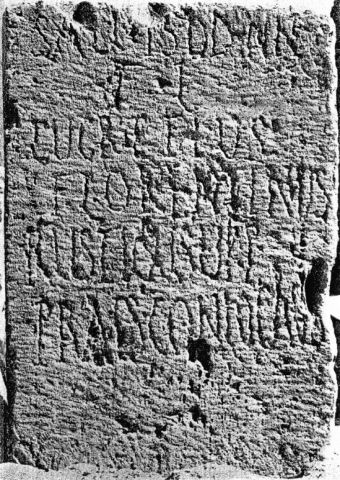
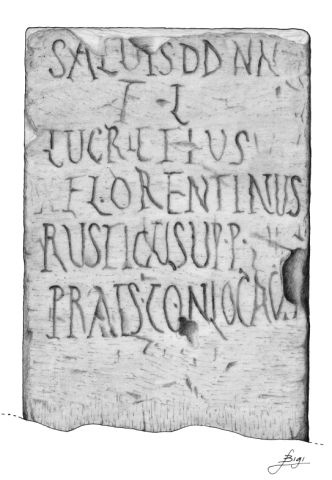
Inscription
Salvis dd(ominis) nn(ostris), / Fl(avius) / Lucretius / Florentinus / (5) Rusticus v(ir) p(erfectissimus) {p} / praes(es) conlocavit.
Inscription translation
For the saftey of our lords. Flavius Lucretius Florentinus Rusticus, of perfectissimus rank, governor (praeses), set this here.
Bibliography
- Tantillo, I. and F. Bigi (eds.), Leptis Magna. Una città e le sue iscrizioni in epoca tardoromana, Cassino 2010, 484-6, no. 90, figs. 10.106-107
Discussion
INSCRIPTION
In six lines:
Salvis dd(ominis) nn(ostris), / Fl(avius) / Lucretius / Florentinus / (5) Rusticus v(ir) p(erfectissimus) {p} / praes(es) conlocavit.
'For the saftey of our lords. Flavius Lucretius Florentinus Rusticus, of perfectissimus rank, governor (praeses), set this here.'
Letter height not recorded.
DESCRIPTION
This limestone base was untraceable in 2010 (see below, ‘Provenance and Current Location’). Photos of it show a rectangular block with smooth faces; it was perhaps provided with separately worked mouldings to make it formally homogeneous to two other bases set up by the same governor (LSA-2219, LSA-2220; see below, ‘Honorand, Awarder and Date’).
From the photographic documentation the surface appears uneven in many places, which would be an indicator that our inscription is carved over an erased earlier one; however, without close examination this hypothesis is not verifiable.
In the Byzantine period, the block was used as building material (see below, ‘Provenance and Current Location’).
PROVENANCE AND CURRENT LOCATION
The inscription was found built into a Byzantine defensive tower built on the outer face of the western wall of the Severan forum, close to the southern entrance of that side. It was untraceable in 2010.
HONORAND, AWARDER AND DATE
Flavius Lucretius Florentinus Rusticus, the awarder, is known from a series of similar inscriptions in Lepcis Magna (our inscription, LSA-2219, LSA-2220, LSA-2222) (PLRE I, 787 Rusticus 1).
For a full discussion of the date and purpose of this inscription, see LSA-2219.
Cite: Last Statues of Antiquity, LSA-2221 (Ignazio Tantillo & Francesca Bigi).