
LSA-2224
Plaque from base for statue of unknown emperor. Sabratha (Tripolitania). 303-315
Record details
Photographs
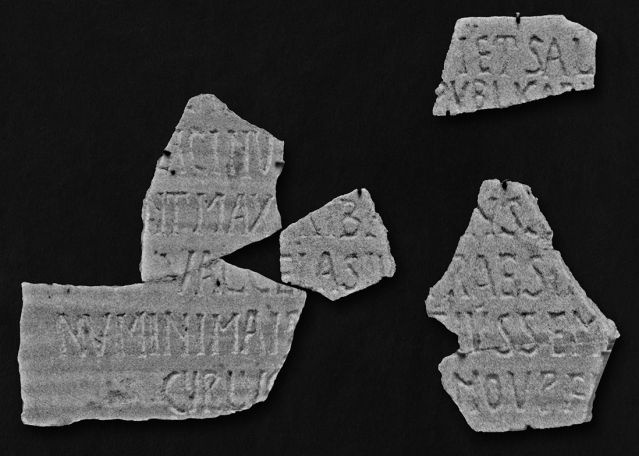
Inscription
Fragment A:
[- - -]+I et sal[ut - - - -] / [- - -] publica++ [- - - ] / - - - - - -
Fragment B:
------ / [- - - Imp(eratori)] Caẹ[s(ari) - - -] / [pio fe]lic(i) invị[cto - - - ] / [- - - po]nt(ifici) max(imo) trib(unicia) p[ot(estate) …]nss(- - -) [- - -] / Val(erius) Gelasiu[s v(ir) p(erfectissimus)] p̣raes(es) pṛ[ov(inciae) Trip(olitanae)] / (5) numini maie[statique] ẹius sem[per dicatus] / cur(ante) L(ucio) Vo[- 9 -]ạmo v(iro) p(erfectissimo) f[l(amine) p(er)p(etuo)? - - -] / [- - - - - -?]
Inscription translation
...and the welfare...common...to the emperor Caesar, pious, fortunate, unconquered, ... pontifex maximus, holder of tribunician power .... Val(erius) Gelasius, of perfectissimus rank, governor (praeses) of the province of Tripolitania, forever dedicated to his divine spirit and majesty [set this up], with Lucius Vo... amus, of perfectissimus rank, perpetual priest (flamen) (?), as overseer.
Bibliography
- Reynolds, J. M. & J. B. Ward-Perkins, The Inscriptions of Roman Tripolitania. In collaboration with S. Aurigemma, R. Bartoccini, G. Caputo, R. Goodchild, P. Romanelli, Roma 1952, 75
- Tantillo, I. and F. Bigi (eds.), Leptis Magna. Una città e le sue iscrizioni in epoca tardoromana, Cassino 2010, 488-9, no. 93, fig. 10.109
Discussion
INSCRIPTION
Fragmentarily preserved in eight lines, two represented here as fragment A (of the inscription), and six as fragment B (see below, 'Description').
Fragment A:
[- - -]+I et sal[ut - - - -] / [- - -] publica++ [- - - ] / - - - - - -
Fragment B:
------ / [- - - Imp(eratori)] Caẹ[s(ari) - - -] / [pio fe]lic(i) invị[cto - - - ] / [- - - po]nt(ifici) max(imo) trib(unicia) p[ot(estate) …]nss(- - -) [- - -] / Val(erius) Gelasiu[s v(ir) p(erfectissimus)] p̣raes(es) pṛ[ov(inciae) Trip(olitanae)] / (5) numini maie[statique] ẹius sem[per dicatus] / cur(ante) L(ucio) Vo[- 9 -]ạmo v(iro) p(erfectissimo) f[l(amine) p(er)p(etuo)? - - -] / [- - - - - -?]
'...and the welfare...common...to the emperor Caesar, pious, fortunate, unconquered, ... pontifex maximus, holder of tribunician power .... Val(erius) Gelasius, of perfectissimus rank, governor (praeses) of the province of Tripolitania, forever dedicated to his divine spirit and majesty [set this up], with Lucius Vo... amus, of perfectissimus rank, perpetual priest (flamen) (?), as overseer.'
Letter height 5.5 – 6 cm.
DESCRIPTION
Five fragments of a marble plaque, white with grey streaks, probably Proconnesian; H 43, W 38 cm. Two of these fragments are adjacent. One fragment (of the plaque) preserves a portion of the upper margin and represents the first two lines of the inscription (fragment A of the inscription). The other four fragments preserve portions of six lines of the inscription (fragment B); one of these, moreover, preserves a portion of the left margin.
This plaque was probably once fixed on a support, probably a statue base, made up of different material.
PROVENANCE AND CURRENT LOCATION
All fragments were found in the favissae (underground store rooms) of the Capitolium of Sabratha (http://www.trismegistos.org/place/16995).
The inscription is now stored in the Sabratha museum (without published inv. no.).
HONORAND, AWARDER AND DATE
The inscription is to an emperor (fragment B, lines 1-3) whose name is lost. The epigraphic formula allows for any emperor of the early 4th century. The most probable is Constantine, since the very rare qualification of the emperor as the defender of the common welfare (salus publica, fragment A) is applied to him in two other statue-base inscriptions, both datable to 312/15 (LSA-1173 (Uchi Maius) and LSA-1647 (Ostia)); it was plausibly restored, moreover, in a further inscription from Sabratha by Reynolds (http://inslib.kcl.ac.uk/irt2009/IRT054.html).
The inscription was set up by Valerius Gelasius, governor (praeses) of the province of Tripolitania (fragment B, line 4). Gelasius is otherwise unknown; however, the creation of the province of Tripolitania in 303 provides a clear terminus post quem for our inscription.
The erection of the inscription was overseen by a local man of high equestrian (perfectissimus) rank, probably a local flamen.
FURTHER DISCUSSION
This inscription was previously published as two different inscriptions, IRT 75 and 87. However, the striking homogeneity of the material suggests that the fragments come from one single inscription.
Discussion references
- Corpus Inscriptionum Latinarum; , VIII 15451
- Corpus Inscriptionum Latinarum; , XIV 131
Cite: Last Statues of Antiquity, LSA-2224 (Ignazio Tantillo with Francesca Bigi).