
LSA-223
Base for statue of Valens, emperor. Aphrodisias (Caria). 364.
Record details
Photographs
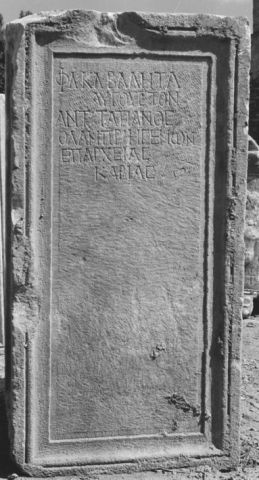
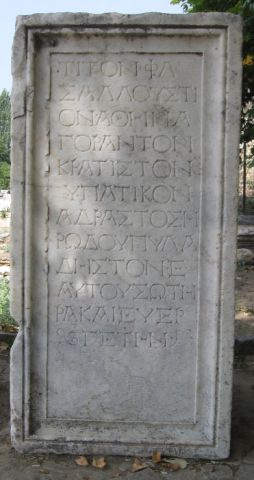
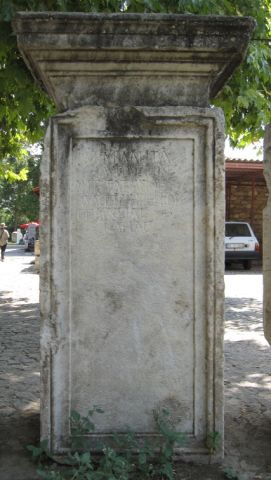
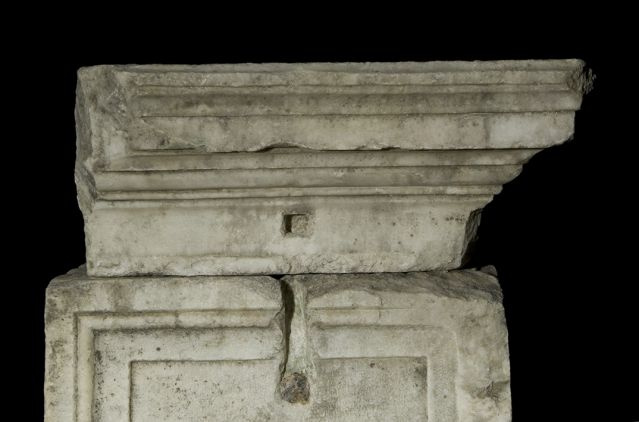
Inscription
Ἀγαθῆι Τύχηι· / Φλ(άουιον) Κλ(αύδιον) Βάλητα / v. Αὔγουστον / Ἀντ(ώνιος) Τατιανὸς / ὁ λαμπρ(ότατος) ἡγεμὼν /(5) ἐπαρχείας / v. Καρίας. leaf
Inscription translation
To Good Fortune. Antonius Tatianus, clarissimus praeses of the province of Caria (set up this statue of) Flavius Claudius Valens, Augustus.
(Trans: C. Roueché)
Bibliography
- Roueché, C., Aphrodisias in Late Antiquity (Journal of Roman Studies Monograph 5), London 1989, no. 21
Discussion
INSCRIPTION
In five lines:
Ἀγαθῆι Τύχηι· / Φλ(άουιον) Κλ(αύδιον) Βάλητα / v. Αὔγουστον / Ἀντ(ώνιος) Τατιανὸς / ὁ λαμπρ(ότατος) ἡγεμὼν /(5) ἐπαρχείας / v. Καρίας. leaf
'Antonius Tatianus, clarissimus praeses of the province of Caria (set up this statue of) Flavius Claudius Valens, Augustus.'
Letter height 3 - 5.5 cm.
On the other side was a second century inscription for a man from his tomb monument. It was stuccoed over. It reads, in translation, Titus Flavius Sallustius Athenagoras the best consular. Adrastos Herodes Pylades (set this up) for his savior and benefactor
DESCRIPTION
Composite base of lower element, rectangular shaft, moulded upper element. Upper element, H: 26.5, W: 75.5, D: 64, W (at bottom) 52.5 cm. Rectangular shaft, H: 119, W: 59, D: 58 cm. Lower element, W: 86, D: 84 cm. Medium to large grained white marble.
The upper crowning element is well-preserved and features the first line of the inscription. The moulding at its back has been deliberately removed. A cutting for the head of a clamp is visible on each side in the broad fascia of the moulding; the bar of the clamp breaks the projecting band below. These clamp cuttings align perfectly with those on the sides of the base. The cuttings for the lower head of the clamps and the remainder of the bar are deeply cut into the rectangular shaft since the upper crowning element is smaller than the base and leaves 3 cm on either side uncovered.
The top of the upper element was originally used for a bronze statue. It has impressions for both feet and two large square dowel holes. One of the dowel holes is behind the right foot which steps slightly forward (and probably did not bear the weight). The other dowel hole loosely corresponds to the heel of the left foot; it is set at the outside of the foot and backward of centre. These square dowel holes have been enlarged in order to be removed.
PROVENANCE AND CURRENT LOCATION
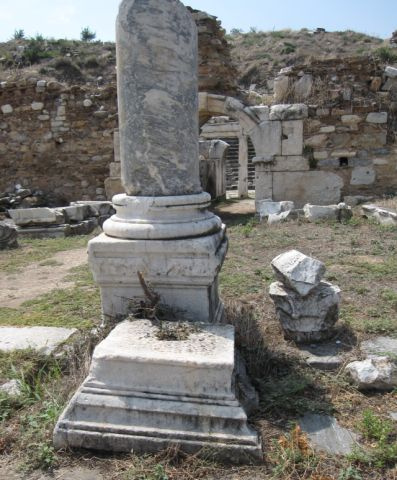
The upper moulding was discovered in 1971 amid the blocks inside the so-called Porta Regia, the arch from the Theatre stage building to the area east of it. In 1972 in order to excavate the area of the Theatre a passageway was pierced through the medieval wall behind the stage building at the point of the Porta Regia. The base was discovered in the wall east of the Porta Regia at the ‘width of the arched doorway’. The base was placed in the wall so that the inscription was facing up and invisible. When the base was turned over, the excavators discovered that the opposite side had been cemented or stuccoed over. This was removed and revealed an earlier inscription of probably the second century AD. This base rested on a moulded pedestal which is still in situ in front of the fifth column from the north of the western stoa, that which is just to the north of Porta Regia.
HONORAND, AWARDER AND DATE
This monument was erected by the senatorial governor Antonius Tatianus for Valens who became emperor in March of 364. Antonius Tatianus , who refurbished the area of the Tetrastoon at Aphrodisias, was already in office when Julian was Emperor and had set up a statue for Julian (LSA-197) in the Tetrastoon. His honour for Valens is similar in conception, adjacent in location, and was close chronologically. He probably had this statue erected early in the reign of Valens, almost immediately upon accession. Notably the new emperor’s nomina are incorrectly given as Flavius Claudius, which were those of the preceding dynasty.
Cite: Last Statues of Antiquity, LSA-223 (J. Lenaghan).