
LSA-2234
Base for statue of Constantius II, emperor. Cirta (Numidia). 337-361
Record details
Photographs
Inscription
Domino or[bi]s, in/victo ac perpet(uo) / principi, d(omino) n(ostro) Fl(avio) Iulio / Constantino (sic), victori, / (5) semper Aug(usto), / Fl(avius) Ovidius Aptho/n(i)us, v(ir) c(larissimus), cons(ularis).
Inscription translation
To the lord of the world, unconquered and eternal ruler, our lord Flavius Iulius Constantinus, victor, forever Augustus; Flavius Ovidius Apthonius, of clarissimus rank, governor (consularis), [set this up].
Bibliography
- L'Année épigraphique, Paris, 2005, no. 1695
Discussion
INSCRIPTION
In seven lines:
Domino or[bi]s, in/victo ac perpet(uo) / principi, d(omino) n(ostro) Fl(avio) Iulio / Constantino (sic), victori, / (5) semper Aug(usto), / Fl(avius) Ovidius Aptho/n(i)us, v(ir) c(larissimus), cons(ularis).
'To the lord of the world, unconquered and eternal ruler, our lord Flavius Iulius Constantinus, victor, forever Augustus; Flavius Ovidius Apthonius, of clarissimus rank, governor (consularis), [set this up].'
Letter height : 3 cm
DESCRIPTION (from Benseddik)
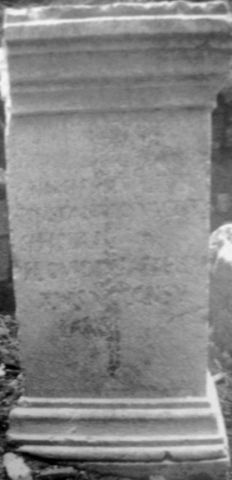
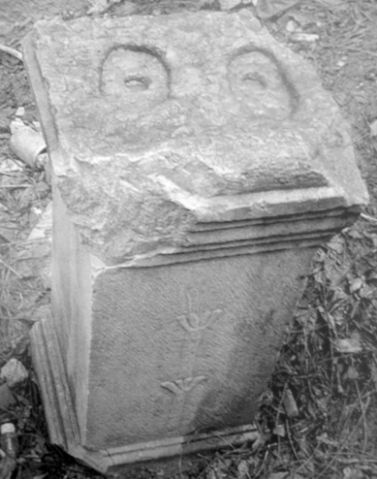
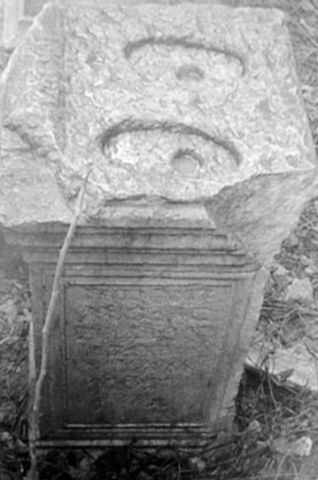
Limestone base with plinth and crown moulding on all sides, a re-used base for an earlier statue: H 111, W 45, D 45 cm. Our inscription is associated with two footprints (with fixing holes), for a bronze statue, cut into the top of the base. On what is now the left side of the base, are the traces of an earlier inscription, that has been erased to the point of being illegible. On what is now the back of the base, are two bunches of leaves that Benseddik identified as sage ('décoré sur un côté par une feuille de sauge'), which must be associated with the first use of the base.
PROVENANCE AND CURRENT LOCATION
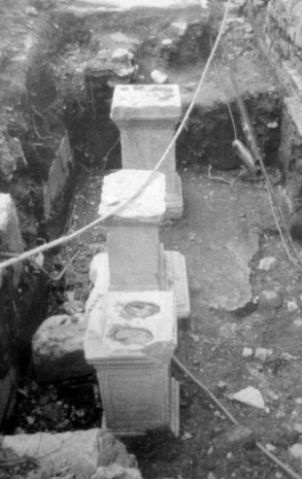
Our base was found, apparently in its original location, during excavations undertaken during restoration of the Bey's palace, and was first published by Benseddik in 2005. It was discovered aligned with two other bases including one that is uninscribed (see for the other inscribed base LSA-2520). It was left in situ.
HONORAND, AWARDER AND DATE
The honorand, Constantius II, was Augustus from 337 to 361.
The awarder, Flavius Ovidius Apthonus, governor of Numidia, is known only from our inscription. Five governors of Numidia are known during the reign of Constantius II (see PLRE I, pp. 1086-7). The governorship of one of them, Ceionius Italicus (PLRE I, 466, Italicus 3), can be precisely dated to 343. So our Flavius Ovidius Apthonus must have been governor within the period, either 337-42 or 344-61.
FURTHER DISCUSSION
The re-use of statue bases seems to have been quite common under the reign of Constantius II (see LSA-2242, LSA-2250 and perhaps LSA-2375). Lepelley demonstrated that African cities experienced an economic and financial crisis under the reign of Constantine and his sons, largely due to the imperial tax (Lepelley, 1979, 97-8). Thus, the re-use of material must have been a common practice at this time, when it became urgent to save money.
Cite: Last Statues of Antiquity, LSA-2234 (Gabriel de Bruyn).