
LSA-2236
Base for statue of Diocletian, emperor. Cuicul (Numidia). 287
Record details
Photographs
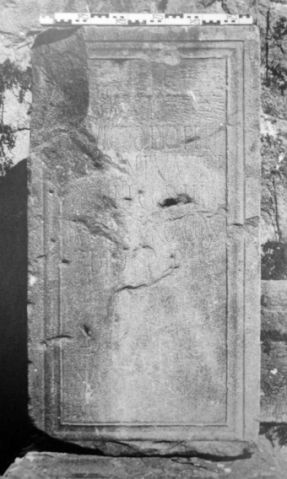
Inscription
[[[Im]p(eratori) Caes(ari) C(aio) Vale/[ri]o Diocletiano]], / [in]victo, pio, fel(ici) / [Aug(usto)], pont(ifici) max(imo), trib(unicia) / pot(estate) IIII, co(n)s(uli) III, / imp(eratori) [III(?)], proco(n)s(uli), / d(ecreto) d(ecurionum), p(ecunia) p(ublica).
Inscription translation
To the emperor Caesar Caius Valerius Diocletianus, unconquered, pious, fortunate Augustus, highest priest, holding tribunician power four times, consul three times, acclaimed victor three (?) times, proconsul; [set up] by decree of the councillors, with public funds.
Bibliography
- Lepelley, C., Les cités de l'Afrique romaine au Bas-Empire, t. 2, Notices d'histoire municipale, Paris 1981, p. 409, no 3
- Pflaum, H.-G., Inscriptions Latines de l'Algérie. 2. Inscriptions de la confédération cirtéenne, de Cuicul et de la tribu des Suburbures. Vol. 3, Paris 2003, no 7856
- Zimmer, G., Wesch-Klein, G., Locus datus decreto decurionum : zur Statuenaufstellung zweier Forumsanlagen im römischen Afrika, München, 1989, p. 54, C1
Discussion
INSCRIPTION
In seven lines:
[[[Im]p(eratori) Caes(ari) C(aio) Vale/[ri]o Diocletiano]], / [in]victo, pio, fel(ici) / [Aug(usto)], pont(ifici) max(imo), trib(unicia) / (5) pot(estate) IIII, co(n)s(uli) III, / imp(eratori) [III(?)], proco(n)s(uli), / d(ecreto) d(ecurionum), p(ecunia) p(ublica).
'To the emperor Caesar Caius Valerius Diocletianus, unconquered, pious, fortunate Augustus, highest priest, holding tribunician power four times, consul three times, acclaimed victor three (?) times, proconsul; [set up] by decree of the councillors, with public funds.'
Letter height : 6 cm
The first two lines, with the name of Diocletian, have been carefully erased with a chisel, though some of their letters can still be deciphered.
DESCRIPTION (from Pflaum)
Rectangular base with plinth. The crown is missing. The inscription is framed within a moulding. H 117, W 63, D 54 cm.
PROVENANCE AND CURRENT LOCATION
Found in the old forum,according to Zimmer and Wesch-Klein, in front of the Curia. It remains where it was found.
HONORAND, AWARDER AND DATE
The honorand, Diocletian (full name Caius Aurelius Valerius Diocletianus, here Caius Valerius Diocletianus), was Augustus from 284 to 305.
The awarder was the city, as usual for imperial statues in Africa.
Diocletian held tribunician power (tribunicia potestas) for the fourth time between 10 December 286 and 9 December 287. His third consulship was in the year 287. Our base can therefore be dated to 287.
FURTHER DISCUSSION
Diocletian never suffered secular disgrace, so the careful erasure of his name was almost certainly done by Christians eager to destroy the memory of one of the great persecutors. Other bases in Cuicul, to emperors whom Christians regarded as notorious pagans, were similarly defaced (LSA-2237, LSA-2238, LSA-2239, LSA-2240).
Cite: Last Statues of Antiquity, LSA-2236 (Gabriel de Bruyn).