
LSA-2238
Base for statue of Maximian or Maxentius, emperors. Cuicul (Numidia). 285-286 or 306 ?
Record details
Photographs
Inscription
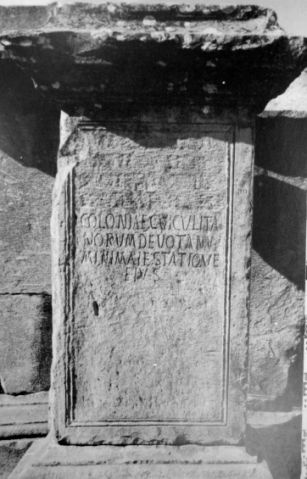
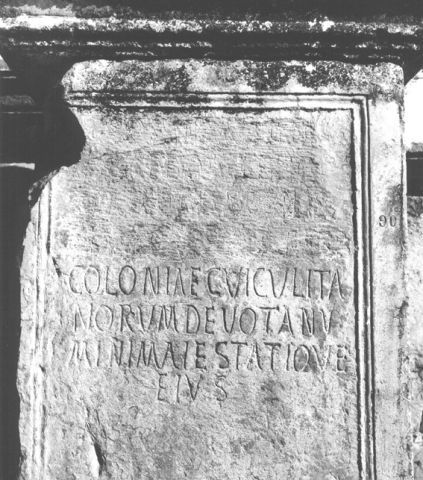
[[Domino nostro]] / [[M(arco) Aurelio Valerio]] / [[Maximi(a)no (or Maxentio ?), nobilis]]/[[simo Caesari; res p(ublica)]] / (5) coloniae Cuiculita/norum, devota nu/mini maiestatique / eius.
Inscription translation
To our lord Marcus Aurelius Valerius Maximianus (or Maxentius ?), most noble Caesar; the community (res publica) of the colony of the Cuiculitani, devoted to his divine spirit and majesty, [set this up].
Bibliography
- Pflaum, H.-G., Inscriptions Latines de l'Algérie. 2. Inscriptions de la confédération cirtéenne, de Cuicul et de la tribu des Suburbures. Vol. 3, Paris 2003, no. 7864
- Zimmer, G., Wesch-Klein, G., Locus datus decreto decurionum : zur Statuenaufstellung zweier Forumsanlagen im römischen Afrika, München, 1989, p. 60, C19
Discussion
INSCRIPTION
In eight lines:
[[Domino nostro]] / [[M(arco) Aurelio Valerio]] / [[Maximi(a)no (or Maxentio ?), nobilis]]/[[simo Caesari; res p(ublica)]] / (5) coloniae Cuiculita/norum, devota nu/mini maiestatique / eius.
'To our lord Marcus Aurelius Valerius Maximianus (or Maxentius ?), most noble Caesar; the community (res publica) of the colony of the Cuiculitani, devoted to his divine spirit and majesty, [set this up].'
Letter height : 4.5 cm
The first four lines, with the name of the emperor, have been deliberately erased.
DESCRIPTION (from Pflaum)
Rectangular base with separately worked plinth and crown. The right side is decorated with a patera, and the left with an urceus; since these do not normally feature on statue bases in Africa in this period, their presence may well show that this was a re-used piece, perhaps formerly an altar. The inscription is framed with a moulding. H 115, W 67, D 60 cm.
PROVENANCE AND CURRENT LOCATION
Found in the old forum. Zimmer and Wesch-Klein describe it as in the centre of the square, set against a larger base (probably for a quadriga). It remains where it was found.
HONORAND, AWARDER AND DATE
Under the erasure, Pflaum identified the honorand as Maximian, Caesar from 285 to 286. However, X. Dupuis (in Pflaum, 2003), who re-examined the base, read 'Maxentio', rather than 'Maximino'. Maxentius was proclaimed Augustus in 306 (ruling until 312), and was never a Caesar. However, another inscription found in Numidia honours him as 'most noble Caesar' (CIL VIII 22346). If he was our honorand, our base was possibly dedicated at the very beginning of his reign, before he took the title of Augustus and while he was being honoured as 'princeps invictus, unconquered prince' by the mint of Rome.
The awarder was the city, as usual for imperial statues in Africa.
FURTHER DISCUSSION
The erasure of the emperor's name was almost certainly done by Christians, since other bases in Cuicul to emperors whom Christians regarded as notorious pagans, were similarly defaced (LSA-2236, LSA-2237, LSA-2239, LSA-2240).
Cite: Last Statues of Antiquity, LSA-2238 (Gabriel de Bruyn).