
LSA-2240
Base for statue of a 'most noble Caesar'. Cuicul (Numidia). 215-361
Record details
Photographs
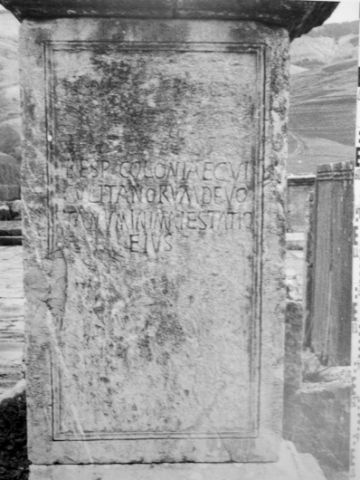
Inscription
[[[--- / --- / --- no]]]/[[bilissimo Caesari]]; / (5) res p(ublica) coloniae Cui/culitanorum, devo/ta numini maiestatiq(ue) / eius.
Inscription translation
To ... most noble Caesar; the community (res publica) of the colony of the Cuiculitani, devoted to his divine spirit and majesty, [set this up].
Bibliography
- Pflaum, H.-G., Inscriptions Latines de l'Algérie. 2. Inscriptions de la confédération cirtéenne, de Cuicul et de la tribu des Suburbures. Vol. 3, Paris 2003, no. 7863
- Zimmer, G., Wesch-Klein, G., Locus datus decreto decurionum : zur Statuenaufstellung zweier Forumsanlagen im römischen Afrika, München, 1989, p. 67, C53
Discussion
INSCRIPTION
In eight lines:
[[[--- / --- / --- no]]]/[[bilissimo Caesari]]; / (5) res p(ublica) coloniae Cui/culitanorum, devo/ta numini maiestatiq(ue) / eius.
'To ... most noble Caesar; the community (res publica) of the colony of the Cuiculitani, devoted to his divine spirit and majesty, [set this up].'
Letter height : 4.5 cm
The first four lines, with the name and titles of the imperial honorand, have been deliberately erased, leaving only enough traces to show that this was a dedication to a Caesar. Pflaum proposed to complete them as follows : '[[[Magno et invicto domino nostro Maximiano, no]]]/[[bilissimo Caesari]]'.
DESCRIPTION (from Pflaum and Wesch-Klein)
Rectangular base, with separately worked plinth and crown: H 127, W 68, D 61 cm.
PROVENANCE AND CURRENT LOCATION
Found in 1913 by Ballu in the ruins of the old forum, within the basilica, where it remains.
HONORAND, AWARDER AND DATE
Pflaum suggested Galerius as the honorand, but admitted that there were many other possible ways to complete the inscription. The title 'nobilissimus Caesar' was conferred for the first time on Geta (Caesar 198-209), and for the last time on Julian (Caesar 355-61). The final formula, 'devota numini maiestatique eius', is first recorded in this form in 215 (see Chastagnol, 17-8 and 35-6).
The awarder was the city, as usual for imperial statues in Africa.
Discussion references
- Chastagnol, A. "Le formulaire de l'épigraphie latine officielle dans l'Antiquité Tardive", Donati, A. (ed.), La terza età dell'Epigrafia, Faenza 1988, 17-18 and 35-36
Cite: Last Statues of Antiquity, LSA-2240 (Gabriel de Bruyn).