
LSA-2242
Base for statue, perhaps for Constans I, emperor, later dedicated to Constantius II. Uthina or Pagus Mercurialis Veteranorum Medelitanorum ? (Proconsularis). 337-339
Record details
Photographs
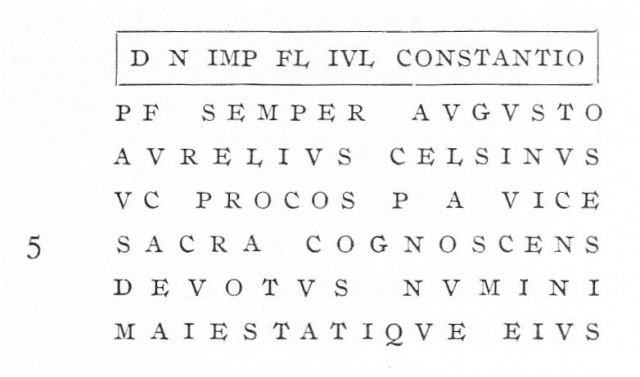
Inscription
D(omino) n(ostro) imp(eratori) Fl(avio) Iul(io) Constantio, / p(io), f(elici), semper Augusto, / Aurelius Celsinus, / v(ir) c(larissimus), proco(n)s(ul) p(rovinciae) A(fricae), vice / (5) sacra cognoscens, / devotus numini / maiestatique eius.
Inscription translation
To our lord emperor Flavius Iulius Constantius, pious, fortunate, forever Augustus; Aurelius Celsinus, of clarissimus rank, governor (proconsul) of the province of Africa, judge representing the emperor, devoted to his divine spirit and majesty, [set this up].
Bibliography
- Merlin, A., Inscriptions latines de la Tunisie, Paris, 1944, no. 757
Discussion
INSCRIPTION
In seven lines:
D(omino) n(ostro) imp(eratori) Fl(avio) Iul(io) Constantio, / p(io), f(elici), semper Augusto, / Aurelius Celsinus, / v(ir) c(larissimus), proco(n)s(ul) p(rovinciae) A(fricae), vice / (5) sacra cognoscens, / devotus numini / maiestatique eius.
'To our lord emperor Flavius Iulius Constantius, pious, fortunate, forever Augustus; Aurelius Celsinus, of clarissimus rank, governor (proconsul) of the province of Africa, judge representing the emperor, devoted to his divine spirit and majesty, [set this up].'
Letter height: 8 - 5 cm
DESCRIPTION (from Ben Hassen and Maurin)
Rectangular statue base of white marble, with separately worked plinth and crown, and mouldings top and bottom ('base moulurée en haut et en bas, avec socle et couronnement'). The top and the bottom are damaged by major breaks ('éclats importants en haut et en bas'): H 122, W 60, D 30 cm. The text is framed within a moulding ('cadre mouluré délimitant le champ épigraphique'). There are signs that our dedication partly replaces an earlier one (see below, 'Further Discussion').
PROVENANCE AND CURRENT LOCATION
Our base was first published by Poinssot from Saumagne's notes in 1928-1929. It was found on the property of Madame Quignolot, near the Bordj Bou Rbia (the ancient 'Pagus Mercurialis Veteranorum Medelitanorum'), some 4 kilometres west of the Capitolium of Uthina. It is now in the Oudhna storerooms.
HONORAND, AWARDER AND DATE
The honorand, Constantius II, was Augustus from 337 to 361. But the base was perhaps first dedicated to Constans I, Augustus 337-50 (see below, 'Further Discussion').
The awarder, Aurelius Celsinus (PLRE, I, 192, Celsinus 4), was proconsul of Africa between 337 and 339, which provides us with a reliable date of 337-9 for the first dedication of this base.
FURTHER DISCUSSION
The first line of our inscription, with the full name of Constantius II (Flavius Iulius Constantius), is carved into a lowered field, presumably replacing an earlier imperial name, that had been deliberately and thoroughly erased. Ben Abdallah, Ben Hassen and Maurin hypothesise that the original dedication (which can be dated to within the period 337-9) was to Constans, the effective ruler of Africa from 337 to 350, and that this was erased between 350 and 353, when Magnentius (who had deposed Constans) ruled Africa. At a yet later date, after Magnentius had been defeated by Constantius II, this latter emperor became the honorand (perhaps after a period when the base bore the name of Magnentius). If this reconstruction is correct, and it seems reasonable, it is an interesting case of an imperial statue being rededicated with only minimal changes to the inscription (and, probably, no changes to the statue above).
The re-use of statue bases seems to have been quite common under the reign of Constantius II (see LSA-2234, LSA-2250 and perhaps LSA-2375). Lepelley demonstrated that African cities experienced an economic and financial crisis under the reign of Constantine and his sons, largely due to the burden of imperial taxation (Lepelley, 1979, 97-8). Thus, the re-use of material may have become a common practice at this time, when it became urgent to save money.
Cite: Last Statues of Antiquity, LSA-2242 (Gabriel de Bruyn).