
LSA-2243
Base for statue of Constantius I, emperor. Cuicul (Numidia). 293-305
Record details
Photographs
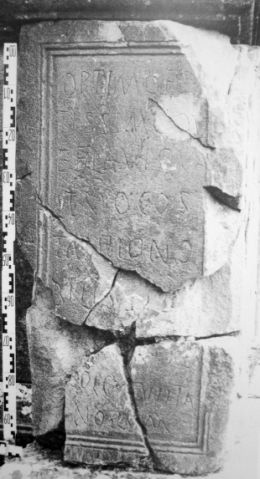
Inscription
Optimo for/tissimoqu/e, Flavio Va/lerio Co(n)s/tantio, no/bilissi[mo] / (7) [Caes]ari; res / [p(ublica)] col(oniae) Cu[i]culita/norum.
Inscription translation
To the best and most powerful, Flavius Valerius Constantius, most noble Caesar; the community (res publica) of the colony of the Cuiculitani [set this up].
Bibliography
- Lepelley, C., Les cités de l'Afrique romaine au Bas-Empire, t. 2, Notices d'histoire municipale, Paris 1981, p. 409, no. 5
- Pflaum, H.-G., Inscriptions Latines de l'Algérie. 2. Inscriptions de la confédération cirtéenne, de Cuicul et de la tribu des Suburbures. Vol. 3, Paris 2003, no. 7862
- Zimmer, G., Wesch-Klein, G., Locus datus decreto decurionum : zur Statuenaufstellung zweier Forumsanlagen im römischen Afrika, München, 1989, p. 62, C25
Discussion
INSCRIPTION
In nine lines:
Optimo for/tissimoqu/e, Flavio Va/lerio Co(n)s/tantio, no/bilissi[mo] / (7) [Caes]ari; res / [p(ublica)] col(oniae) Cu[i]culita/norum.
'To the best and most powerful, Flavius Valerius Constantius, most noble Caesar; the community (res publica) of the colony of the Cuiculitani [set this up].'
Letter height : 5 - 4 cm
We give the inscription with the completions suggested by Pflaum. G. Wesch-Klein adds an extra line after 'Caesari' (l. 7), which is obviously a mistake, from what we can see on the photograph.
DESCRIPTION (from Pflaum and the published photograph)
Rectangular base, broken into several pieces: H 107, W 55, D 60 cm. The text is framed within a moulding.
PROVENANCE AND CURRENT LOCATION
Found in 1913 by Ballu in the ruins of the old forum, who provides no data as to the precise findspot. According to Pflaum, our base was found within the forum basilica, whereas Zimmer and Wesch-Klein situate it in the centre of the forum, against an equestrian statue base, which is where it is still located. Confusion over the precise findspot is perhaps a consequence of the reorganisation of the old forum by the first archeologists, who rebuilt the bases they discovered.
HONORAND, AWARDER AND DATE
The honorand, Constantius I, was Caesar from 293 to 305. G. Wesch-Klein hesitates between Constantius I and Constantius II. However, the name Flavius Valerius Constantius can only refer to the first, as Constantius II was named Flavius Iulius Constantius.
The awarder was the city, as usual for imperial statues in Africa.
Cite: Last Statues of Antiquity, LSA-2243 (Gabriel de Bruyn).