
LSA-2246
Base for statue of Constantine I, emperor. Cuicul (Numidia). 314
Record details
Photographs
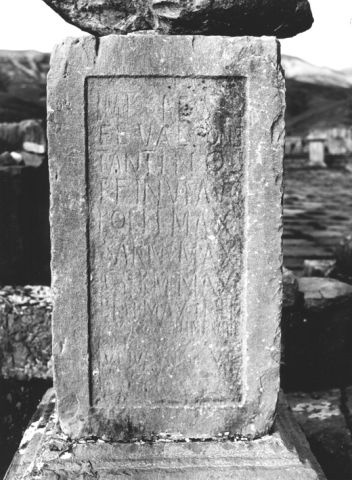
Inscription
Imp(eratori) Caes(ari), / Fl(avio) Val(erio) Cons/tantino, / pio, f(elici), invt(cto) (sic) Aug(usto), / pont(ifici) max(imo), / (5) Sarm(atico) max(imo), / Germ(anico) max(imo), / Brit(annico) max(imo), tribun(icia) / p(otestate) X, cons(uli) III, imp(eratori) VIIII, / p(atri) p(atriae), pro[co(n)s(uli)], / (10) Iul(ius) Iu[v]enali[s], v(ir) p(erfectissimus), / rat(ionalis), devotus nu/mini eius.
Inscription translation
To the emperor Caesar Flavius Valerius Constantinus, pious, fortunate, unconquered Augustus, chief priest, greatest victor over the Sarmatians, greatest victor over the Germans, greatest victor over the Britons, holding tribunician power ten times, consul three times, acclaimed victor (imperator) nine times, father of the fatherland, proconsul. Iulius Iuvenalis, of perfectissimus rank, rationalis, devoted to his divine spirit, [set this up].
Bibliography
- Pflaum, H.-G., Inscriptions Latines de l'Algérie. 2. Inscriptions de la confédération cirtéenne, de Cuicul et de la tribu des Suburbures. Vol. 3, Paris 2003, no. 7868
- Zimmer, G., Wesch-Klein, G., Locus datus decreto decurionum : zur Statuenaufstellung zweier Forumsanlagen im römischen Afrika, München, 1989, p. 67, C52
Discussion
INSCRIPTION
In eleven lines:
Imp(eratori) Caes(ari), / Fl(avio) Val(erio) Cons/tantino, / pio, f(elici), invt(cto) (sic) Aug(usto), / pont(ifici) max(imo), / (5) Sarm(atico) max(imo), / Germ(anico) max(imo), / Brit(annico) max(imo), tribun(icia) / p(otestate) X, cons(uli) III, imp(eratori) VIIII, / p(atri) p(atriae), pro[co(n)s(uli)], / (10) Iul(ius) Iu[v]enali[s], v(ir) p(erfectissimus), / rat(ionalis), devotus nu/mini eius.
'To the emperor Caesar Flavius Valerius Constantinus, pious, fortunate, unconquered Augustus, chief priest, greatest victor over the Sarmatians, greatest victor over the Germans, greatest victor over the Britons, holding tribunician power ten times, consul three times, acclaimed victor (imperator) nine times, father of the fatherland, proconsul. Iulius Iuvenalis, of perfectissimus rank, rationalis, devoted to his divine spirit, [set this up].'
Letter height : 5 - 3.5 cm
We give the inscription as published by Pflaum. The numbers of tribunician powers and consulships given by Wesch-Klein are probably wrong, since they would date our base to 312, while our awarder, Iulius Iuvenalis, almost ceratinly held office after 314 (see below, 'Honorand, Awarder and Date') .
DESCRIPTION (from Pflaum, Wesch-Klein and the published photograph)
Rectangular base, with separately worked plinth and crown: H 95, W 54, D 48 cm.
PROVENANCE AND CURRENT LOCATION
Found in 1913 by Ballu in the old forum, within the basilica, where it is still standing.
HONORAND, AWARDER AND DATE
The honorand, Constantine I, was Augustus from 306 to 337.
The awarder, Iulius Iuvenalis (PLRE I, 491, Iuvenalis), was a rationalis, an imperial financial official, in this context operating at diocesan level. From a statue dedication that he set up to Constantine in Cirta (LSA-2228), we know that he was rationalis of Numidia and Mauretania, after the Numidias had been reunited into one province in 314.
He erected a second imperial statue in Cuicul (LSA-2244), probably at the same time as our dedication, either again to Constantine, or to Licinius his co-regent.
Constantine's tenth holding of tribunician power (tribunicia potestas) was between 10 December 314 and 9 December 315. His third consulship was in the year 313, his fourth in 315. The details of Constantine's tribunician power and consulships therefore fix the dedication of our base to between 10 and 31 December 314.
FURTHER DISCUSSION
This base and another, probably dedicated to the same Constantine or to Licinius (LSA-2244), have the same awarder and seem very similar to Pflaum. They must have been set up as a pair.
Cite: Last Statues of Antiquity, LSA-2246 (Gabriel de Bruyn).