
LSA-225
Statue base for Dulcitius, governor. Aphrodisias (Caria). Mid fifth century.
Record details
Photographs
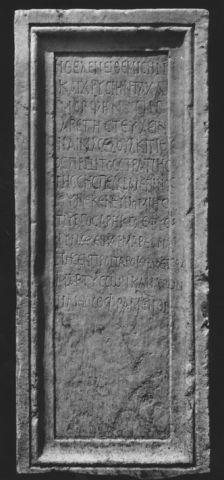
Inscription
ἤθελεν, εἰ θέμις ἦν, / καὶ χρυσίην τάχα / μορφὴν vac. / σῆς / ἀρετῆς τεύχειν / (5) ναί, μά σε, Δουλκίτιε, scroll / ὃς πρῶτος στρατίης / τῆς σῆς πέλε, Βαλεριανός, / οὕνεκεν εὐνομίης / πύργος ἄρηκτος ἔφυς. scroll / (10) νῦν δέ σε μαρμάρεον / στῆσεν προπάροιθε λοετροῦ / μάρτυς σῶν καμάτων ) ἡ λίθος ὄφρα μένοι.
cross τόπος / αρχεψε / θρεμοπ / ο vac.
Inscription translation
If it was permitted, Valerianus, who was the leader of your troop, would have wished to make even a golden image of your virtue - indeed (I swear) by yourself. Dulcitius, because you were an unbroken tower of lawfulness. But now he has set you in marble in front of the baths, so that the stone may remain as a witness of your labours.
Place of ?chief hot-food-seller.
(Trans: C. Roueché)
Bibliography
- Roueché, C., Aphrodisias in Late Antiquity (Journal of Roman Studies Monograph 5), London 1989, no. 41
Discussion
INSCRIPTION
Verse inscription of three elegiac distichs laid out in 13 lines:
ἤθελεν, εἰ θέμις ἦν, / καὶ χρυσίην τάχα / μορφὴν.
σῆς / ἀρετῆς τεύχειν / (5) ναί, μά σε, Δουλκίτιε, scroll /
ὃς πρῶτος στρατίης / τῆς σῆς πέλε, Βαλεριανός, /
οὕνεκεν εὐνομίης / πύργος ἄρηκτος ἔφυς. scroll /
(10) νῦν δέ σε μαρμάρεον / στῆσεν προπάροιθε λοετροῦ /
μάρτυς σῶν καμάτων / ἡ λίθος ὄφρα μένοι.
'If it was permitted, Valerianus, who was the leader of your troop, would have wished to make even a golden image of your virtue - indeed (I swear) by yourself. Dulcitius, because you were an unbroken tower of lawfulness. But now he has set you in marble in front of the baths, so that the stone may remain as a witness of your labours.'
Letter height 2-3 cm.
On proper right side:
cross τόπος / αρχεψε / θρεμοπ/ο
Place of ?chief hot-food-seller.
(Trans: C. Roueché)
DESCRIPTION
Rectangular base. H: 107.5, W: 44.5, D: 44.5 cm. White marble.
The base is in good condition with a small marble flaw at the back near the top. The upper surface has a lewis hole and a pour channel. The front and sides have framing mouldings; the back does not. There is a graffito on the proper right (viewer’s left) panel which has been tapped in with a round-headed instrument.
PROVENANCE AND CURRENT LOCATION
The block was extracted in 1972 (exc. inv. 72-200) from the Byzantine wall behind the Theatre stage building. It was in the southern part of this wall. The reference in the text to the Baths suggests that it was once set up in the southern stoa of the Tetrastoon court because one entered the ‘Theatre’ Baths from the southern stoa. Moreover, other trade topos inscriptions, like that on the proper right side of this base, were found in the large hall of the ‘Theatre’ Baths.
HONORAND, AWARDER AND DATE
The honorand Dulcitius was a governor. The references to law and to labours suggest this, and a verse inscribed on the Agora Gate to him as the restorer of the Gate makes his post as praeses explicit (see under http://insaph.kcl.ac.uk/ala2004/inscription/eAla040.html). In the verse inscription on the Gate, he is also assigned the traditional terms and roles agonothete, ktistes, and philotimos, as well as Maioumarch. Maioumarch means that he participated in some way, probably by giving money to this nocturnal Syrian festival, which was popular and vulnerable to imperial restrictions: in 396 the restriction was removed only to be replaced in 399. However, it is attested during the fifth century.
The statue was set up by an individual Valerianus, a member of Dulcitius’ staff. Although the bureaucratic role of the dedicator is unusual, three of the four fully-preserved, late-antique bases in the Tetrastoon were set up by individuals; see the bases for Julian LSA-197, Flavius Palmatus LSA-199, and Valens LSA-223 .
Dulcitius was a praeses of Caria. The Notitia Dignitatum (395-413) calls the governor of Caria a praeses but the during the reign of Anastasius (491-518) Fl. Johannes is called a consular governor of Caria on a milestone at Halicarnassus; thus the position was upgraded. Dulcitius can said securely only to be governor before 518. The connection with a man named Ampelius at the Agora Gate suggests a date in the middle of the century.
FURTHER DISCUSSION
Commentary explaining a stone statue rather than a golden one appears also in LSA-393 from Termessus Maior in Psidia (which probably belongs in the fourth or fifth century). LSA-672, also from Caria, suggests a similar conceit but is terse and difficult to date.
Cite: Last Statues of Antiquity, LSA-225 (J. Lenaghan).