
LSA-2250
Base for statue, probably of Constantius I or Crispus, emperor, possibly re-used for Constantius II. Cuicul (Numidia). 293-337
Record details
Photographs
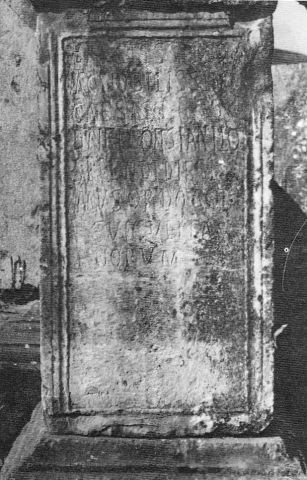
Inscription
Baeatissimo (sic) / ac nobilissimo / Caesari, [[Flavi[o]]],/ d(omino) n(ostro), Fl(avio) Constantio; / (5) splendidissi/mus ordo col(oniae) / Cuiculita/norum.
Inscription translation
To the most blessed and noble Caesar, Flavius, our lord Flavius Constantius; the most splendid council (ordo) of the colony of the Cuiculitani [set this up].
Bibliography
- Lepelley, C., Les cités de l'Afrique romaine au Bas-Empire, t. 2, Notices d'histoire municipale, Paris 1981, p. 410, no. 5
- Pflaum, H.-G., Inscriptions Latines de l'Algérie. 2. Inscriptions de la confédération cirtéenne, de Cuicul et de la tribu des Suburbures. Vol. 3, Paris 2003, no. 7873
- Zimmer, G., Wesch-Klein, G., Locus datus decreto decurionum : zur Statuenaufstellung zweier Forumsanlagen im römischen Afrika, München, 1989, p. 61, C21
Discussion
INSCRIPTION
In seven lines:
Baeatissimo (sic) / ac nobilissimo / Caesari, [[Flavi[o]]],/ d(omino) n(ostro), Fl(avio) Constantio; / (5) splendidissi/mus ordo col(oniae) / Cuiculita/norum.
'To the most blessed and most noble Caesar, Flavius, our lord, Flavius Constantius; the most splendid council (ordo) of the colony of the Cuiculitani [set this up].'
Letter height : 4.5-4 cm
The name of the original honorand, in lines 3 and 4, has been deliberately erased, though Pflaum for his edition of the inscription was able to decipher the name 'Flavio' in line 3. The current text of line 4, 'domino nostro Flavio Constantino', is carved over the second line of the erasure, and represents a rededication of the base.
DESCRIPTION (from Pflaum and the published photograph)
Rectangular base, with separately worked plinth and crown: H 98, W 56, D 58 cm. The inscription is framed within a moulding.
PROVENANCE AND CURRENT LOCATION
Found in 1913 by Ballu in the ruins of the old forum. Zimmer and Wesch-Klein describe it as in the centre of the forum square, set against a larger base (probably for a quadriga). It remains where it was found (inv. no. 87).
HONORAND, AWARDER AND DATE
Pflaum assumes our base was first dedicated to Crispus (full name Flavius Iulius Crispus), who became Caesar in 317 and was put to death by his father Constantine in 324; and that it was then re-used for Constantius II (full name Flavius Iulius Constantius), Caesar from 324 to 337. However, an erased name beginning with 'Flavius' could also fit other emperors: Constantius I and Severus were also named Flavius, and their names could have been erased during Maxentius' rule of Africa in 310-2.
The two most likely reconstructions of the use of our base are: a dedication to Crispus, followed by a dedication to Constantius II after the fall of Crispus in 324 (as suggested by Pflaum); or a dedication to Constantius I (Caesar 293-305), erased by Maxentius during his rule in Africa (310-12), and reinstated after the victory of Constantine (Constantius' father) in 312 (a hypothesis favoured by Lepelley). If this second hypothesis is correct, the second dedication on our base, would not be a new honour, but a reinstatement of the original one.
The awarder was the city, as usual for imperial statues in Africa.
FURTHER DISCUSSION
The re-use of statue bases seems to have been quite common under the reign of Constantius II (see LSA-2234, LSA-2242 and perhaps LSA-2375). Lepelley demonstrated that African cities experienced an economic and financial crisis under the reign of Constantine and his sons, largely due to the imperial tax (Lepelley, 1979, 97-8). Thus, the re-use of material must have been a common practice at this time, when it became urgent to save money.
Cite: Last Statues of Antiquity, LSA-2250 (Gabriel de Bruyn).