
LSA-2251
Base for statue of Constantius I or Constantius II, emperor. Cuicul (Numidia). 305-306 or 337-361
Record details
Photographs
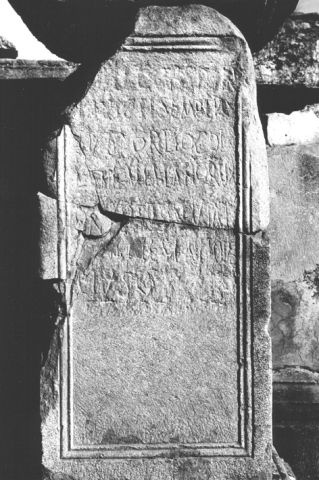
Inscription
[[[Fla]vio Constantio (?)]], / invicti (sic), semper / Aug(usto); ordo col(oniae) / Cuiculitanorum, / (5) d[e]votus numi/n[i] / maiestatique / eius ES.
Inscription translation
To Flavius Constantius (?), unconquered, forever Augustus; the council (ordo) of the colony of the Cuiculitani, devoted to his divine spirit and majesty, [set this up].
Bibliography
- Pflaum, H.-G., Inscriptions Latines de l'Algérie. 2. Inscriptions de la confédération cirtéenne, de Cuicul et de la tribu des Suburbures. Vol. 3, Paris 2003, no. 7874
- Zimmer, G., Wesch-Klein, G., Locus datus decreto decurionum : zur Statuenaufstellung zweier Forumsanlagen im römischen Afrika, München, 1989, p. 60, C18
Discussion
INSCRIPTION
In seven lines:
[[[Fla]vio Constantio (?)]], / invicti (sic), semper / Aug(usto); ordo col(oniae) / Cuiculitanorum, / (5) d[e]votus numi/n[i] / maiestatique / eius ES.
'To Flavius Constantius (?), unconquered, forever Augustus; the council (ordo) of the colony of the Cuiculitani, devoted to his divine spirit and majesty, [set this up].'
Letter height unrecorded.
The first line of the inscription has been deliberately erased, removing the name of the emperor. However enough traces remain to show that this was 'Flavius Constantius'. The final 'ES' in line 7 belong to an earlier inscription.
We give the text as completed by Wesch-Klein. Pflaum suggested a slightly different completion: '[[[---] Costa[n]tii / invicti semper / Aug(usti...'; but we prefer to keep the dative and, with Wesch-Klein, consider the genitive 'invicti' to be a simple error of the stone carver.
DESCRIPTION (from Pflaum and the published photograph)
Rectangular base, broken and lost on the left, with separately worked plinth and crown: H 125, W 60, D 60 cm. The inscriptions is framed within a moulding. Our dedication is carved over an erased earlier inscription, to which the letters ES in line 7 belong.
PROVENANCE AND CURRENT LOCATION
Found in 1913 by Ballu in the ruins of the old forum. Zimmer and Wesch-Klein describe it as in the centre of the square, set against a larger base (probably for a quadriga), where it is still standing (inv. no. 86).
HONORAND, AWARDER AND DATE
Pflaum assumes our base was dedicated to Constantius II (Augustus 337-361, full name Flavius Iulius Constantius) rather than Constantius I (Augustus 305-306, Flavius Valerius Constantius) because of the appearance of the text, the formula and the erasure ('Constance II plutôt que Constance Chlore, vu l'aspect du texte, le formulaire et le martelage'). Wesch-Klein is more cautious and considers both two emperors as possibilities.
If the honorand was Constantius I, the erasure of his name can be explained as done under Maxentius' rule of Africa in 310-312. By contrast, there are no known political circumstance that could have led to the erasure of the name of Constantius II. So on balance we prefer Constantius I as the honorand.
Discussion references
- Lepelley, C., Les cités de l'Afrique romaine au Bas-Empire, t. I, La permanence d'une civilisation municipale, Paris, 1979, p. 97-8
Cite: Last Statues of Antiquity, LSA-2251 (Gabriel de Bruyn).