
LSA-2252
Base for statue of Julian, emperor. Cuicul (Numidia). 361-363
Record details
Photographs
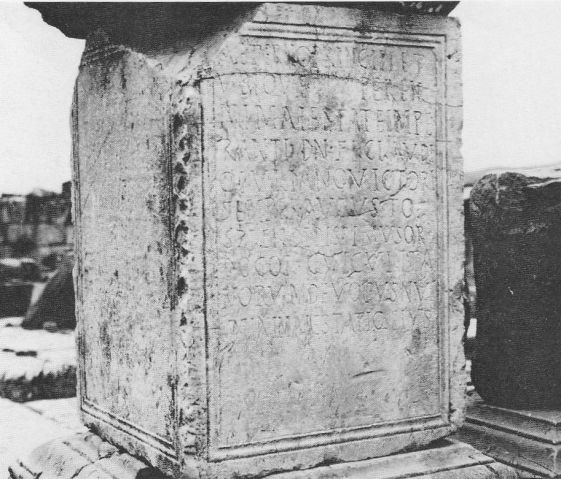
Inscription
Aeterno principi et / ubique peren/ni maiestate impe/ranti, d(omino) n(ostro) Fl(avio) Claudi/o Iuliano, victori, / (6) semper Augusto, / splendidissimus or/do col(oniae) Cuiculita/norum, devotus nu/mini maiestatiq(ue) eius.
Inscription translation
To the eternal prince and one who rules everywhere in perpetual majesty, our lord Flavius Claudius Iulianus, victor, forever Augustus; the most splendid council (ordo) of the colony of the Cuiculitani, devoted to his divine spirit and majesty, [set this up].
Bibliography
- Lepelley, C., Les cités de l'Afrique romaine au Bas-Empire, t. 2, Notices d'histoire municipale, Paris 1981, p. 410, no. 10
- Pflaum, H.-G., Inscriptions Latines de l'Algérie. 2. Inscriptions de la confédération cirtéenne, de Cuicul et de la tribu des Suburbures. Vol. 3, Paris 2003, no. 7875
- Zimmer, G., Wesch-Klein, G., Locus datus decreto decurionum : zur Statuenaufstellung zweier Forumsanlagen im römischen Afrika, München, 1989, p. 62, C24
Discussion
INSCRIPTION
In ten lines:
Aeterno principi et / ubique peren/ni maiestate impe/ranti, d(omino) n(ostro) Fl(avio) Claudi/o Iuliano, victori, / (6) semper Augusto, / splendidissimus or/do col(oniae) Cuiculita/norum, devotus nu/mini maiestatiq(ue) eius.
'To the eternal prince and one who rules everywhere in perpetual majesty, our lord Flavius Claudius Iulianus, victor, forever Augustus; the most splendid council (ordo) of the colony of the Cuiculitani, devoted to his divine spirit and majesty, [set this up].'
Letter height : 5 cm.
DESCRIPTION (from Pflaum and the published photograph)
Rectangular base of limestone, broken at the upper left corner, with separately worked plinth and crown: H 110, W 77, D 80 cm. As the back is rough, the base was probably intended to be placed against a wall. The inscription is framed within a moulding.
PROVENANCE AND CURRENT LOCATION
Found in 1914 by Ballu in the old forum. Zimmer and Wesch-Klein describe it as in the centre of the square, set against a larger base (probably for a quadriga), where it is still standing.
HONORAND, AWARDER AND DATE
Julian was universally acknowledged as Augustus from 361 to 363.
The awarder was the city, as usual for imperial statues in Africa.
Cite: Last Statues of Antiquity, LSA-2252 (Gabriel de Bruyn).