
LSA-2253
Base for statue of Diocletian, emperor. Lambaesis (Numidia). 287-305
Record details
Photographs
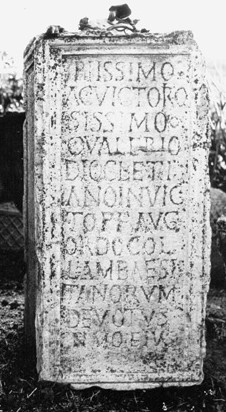
Inscription
Piissimo / ac victorio/sissimo Iovi/o Valerio / (5) Diocletiano, / invic/to, p(io), f(elici) Aug(usto), / ordo col(oniae) / Lambaesi/tanorum, / (11) devotus / n(umini) m(aiestati)q(ue) eius.
Inscription translation
To the most pious and most victorious Iovius Valerius Diocletianus, unconquered, pious, fortunate Augustus; the council (ordo) of the colony of the Lambaesitani, devoted to his divine spirit and majesty, [set this up].
Bibliography
- Compte-rendus des séances de la Commission de l'Afrique du Nord, Bulletin archéologique du Comité des Travaux Historiques et Scientifiques, Paris, 1919, p. 85, no. II
- Lepelley, C., Les cités de l'Afrique romaine au Bas-Empire, t. 2, Notices d'histoire municipale, Paris 1981, p. 422, no. 1
Discussion
INSCRIPTION
In twelve lines:
Piissimo / ac victorio/sissimo, Iovi/o Valerio / (5) Diocletiano, / invic/to, p(io), f(elici) Aug(usto), / ordo col(oniae) / Lambaesi/tanorum, / (11) devotus / n(umini) m(aiestati)q(ue) eius.
'To the most pious and most victorious Iovius Valerius Diocletianus, unconquered, pious, fortunate Augustus; the council (ordo) of the colony of the Lambaesitani, devoted to his divine spirit and majesty, [set this up].'
DESCRIPTION (from A. Ballu, 1919, and the photo on the CIL website)
Rectangular base: H 105, W 54, D 48 cm. The text is framed by a moulding.
PROVENANCE AND CURRENT LOCATION
Our base was found re-used in the south wall of the square adjacent to the southern portico of the temple of Jupiter. It may have come from the square of the Capitolium or from the forum (which is known from an inscription but not yet identified). There is no recent published record of its location.
HONORAND, AWARDER AND DATE
The honorand, Diocletian, was Augustus from 284 to 305.
The awarder was the city, as usual for imperial statues in Africa, here specifically its council (ordo).
In our inscription Diocletian is named 'Iovius' (lines 3-4) because of his claim to be linked with Jupiter. He adopted this new theocratic legitimacy in 287 (see Modéran, 2003, p. 74), in order to consolidate his government, after Carausius was acclaimed as a rival Augustus in Britain in 286. Our base therefore cannot predate 287.
FURTHER DISCUSSION
Another base dedicated to Diocletian (LSA-2254), discovered in the same wall, has a very similar formula to ours. They must have been erected very close in time, perhaps even as a pair.
Discussion references
- Modéran Y., L'Empire romain tardif (235-395 ap. J.-C.), Paris, 2003, p. 74
Cite: Last Statues of Antiquity, LSA-2253 (Gabriel de Bruyn).