
LSA-2254
Base for statue of Diocletian, emperor. Lambaesis (Numidia). 284-305
Record details
Photographs
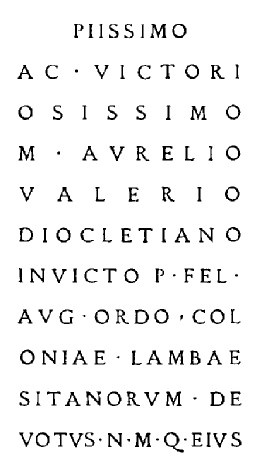
Inscription
Piissimo / ac victori/osissimo, / M(arco) Aurelio / (5) Valerio / Diocletiano, / invicto, p(io), fel(ici), / Aug(usto), ordo col/oniae Lambae/sitanorum de/votus n(umini) m(aiestati)q(ue) eius.
Inscription translation
To the most pious and most victorious, Marcus Aurelius Valerius Diocletianus, unconquered, pious, fortunate Augustus; the council of the colony of the Lambaesitani, devoted to his divine spirit and majesty, [set this up].
Bibliography
- Compte-rendus des séances de la Commission de l'Afrique du Nord, Bulletin archéologique du Comité des Travaux Historiques et Scientifiques, Paris, 1919, p. 86, no. IV
- Lepelley, C., Les cités de l'Afrique romaine au Bas-Empire, t. 2, Notices d'histoire municipale, Paris 1981, p. 422, no. 2
Discussion
INSCRIPTION
In eleven lines:
Piissimo / ac victori/osissimo, / M(arco) Aurelio / (5) Valerio / Diocletiano, / invicto, p(io), fel(ici) / Aug(usto), ordo col/oniae Lambae/sitanorum de/votus n(umini) m(aiestati)q(ue) eius.
'To the most pious and most victorious, Marcus Aurelius Valerius Diocletianus, unconquered, pious, fortunate Augustus; the council (ordo) of the colony of the Lambaesitani, devoted to his divine spirit and majesty, [set this up].'
DESCRIPTION
There are no published descriptions or measurements of this base, and no published image.
PROVENANCE AND CURRENT LOCATION
Our base was found re-used in the south wall of the square adjacent to the southern portico of the temple of Jupiter. It may have come from the square of the Capitolium, or from the forum (which is known from an inscription but not yet identified). There is no recent published record of its location.
HONORAND, AWARDER AND DATE
The honorand, Diocletian, was Augustus from 284 to 305.
The awarder was the city, as usual for imperial statues in Africa, here specifically the council (ordo).
Another base dedicated to Diocletian at Lambaesis (LSA-2253), and discovered in the same wall, has a formula very similar to that of our base, but includes the epithet 'Iovius', celebrating Diocletian's claim to be linked with Jupiter, a claim that he assumed in 287. The two bases are very similar, for instance opening with a reference to Diocletian's great piety, and may be contemporary. It is however just possible that our base dates from the very beginning of the reign, before Diocletian adopted the title of 'Iovius', and that the other base (LSA-2253) was set up around 287 to commemorate his new title.
Discussion references
- Modéran Y., L'Empire romain tardif (235-395 ap. J.-C.), Paris, 2003, p. 74
Cite: Last Statues of Antiquity, LSA-2254 (Gabriel de Bruyn).