
LSA-2255
Base for statue of Diocletian, emperor. Lambaesis (Numidia). 286-293
Record details
Photographs
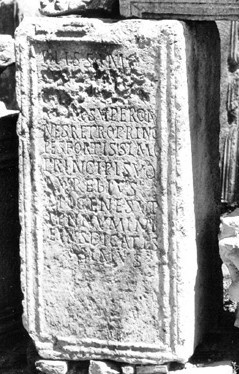
Inscription
Piissimo / [[[imp(eratori) Diocle]]]/[[[tiano], invicto]] / (4) [[[Aug(usto,)]]] ac super om/nes retro princi/pes fortissimo, / principi suo, / Aurelius / Diogenes, v(ir) p(erfectissimus), / (10) p(raeses) p(rovinciae) N(umidiae), numini / eius dicatis/simus.
Inscription translation
To the most pious emperor, Diocletianus, unconquered Augustus and, above all earlier rulers, most powerful; Aurelius Diogenes, of perfectissimus rank, governor (praeses) of the province of Numidia, most devoted to his divine spirit, [set this up] to his emperor.
Bibliography
- Corpus Inscriptionum Latinarum; , VIII, no. 2575
Discussion
INSCRIPTION
In twelve lines:
Piissimo / [[[imp(eratori) Diocle]]]/[[[tiano], invicto,]] / (4) [[[Aug(usto,)]]] ac super om/nes retro princi/pes fortissimo, / principi suo, / Aurelius / Diogenes, v(ir) p(erfectissimus), / (10) p(raeses) p(rovinciae) N(umidiae), numini / eius dicatis/simus.
'To the most pious emperor, Diocletianus, unconquered Augustus, and, above all earlier rulers, most powerful; Aurelius Diogenes, of perfectissimus rank, governor (praeses) of the province of Numidia, most devoted to his divine spirit, [set this up] to his emperor.'
Letter height : 4 cm
The name and title of the emperor in lines 2-4 has been deliberately, and thoroughly erased, but can be completed with reasonable confidence, from the known date of the awarder (see below, 'Honorand, Awarder and Date'), and the existence of a paired base to Diocletian's colleague, Maximian (LSA-2258).
DESCRIPTION (from the CIL and the photograph on the CIL website)
Rectangular base: H 106, W 53 cm, depth unrecorded. The text is framed by a moulding.
PROVENANCE AND CURRENT LOCATION
Our base was found in the military camp, behind the Praetorium. It may still be at its findspot.
HONORAND, AWARDER AND DATE
The honorand, Diocletian, was Augustus from 284 to 305.
The awarder, Aurelius Diogenes (PLRE I, 256, Diogenes 7), was governor of Numidia between 286 and 293, providing the closest dating for our inscription.
FURTHER DISCUSSION
Our base and another dedicated to Maximian by the same awarder (LSA-2258) have the same formula. They must have been set up as a pair.
Diocletian never suffered secular disgrace, so the erasure of his name must have been carried out by Christians eager to destroy the memory of a notorious persecutor. However, other bases to Diocletian in Lambaesis survived unscathed (LSA-2253, LSA-2254).
Cite: Last Statues of Antiquity, LSA-2255 (Gabriel de Bruyn).