
LSA-2257
Base for statue of Maximian, emperor. Lambaesis (Numidia). 286-293
Record details
Photographs
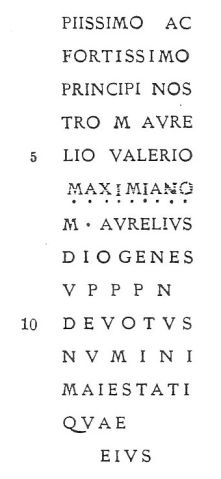
Inscription
Piissimo ac / fortissimo / principi nos/tro, M(arco) Aure/lio Valerio / (6) [[Maximiano]], / M(arcus) Aurelius / Diogenes, / v(ir) p(erfectissimus), p(raeses) p(rovinciae) N(umidiae), / (10) devotus / numini / maiestati/quae (sic) / eius.
Inscription translation
To our most pious and most powerful ruler, Marcus Aurelius Valerius Maximianus; Marcus Aurelius Diogenes, of perfectissimus rank, governor (praeses) of the province of Numidia, devoted to his divine spirit and majesty, [set this up].
Bibliography
- Corpus Inscriptionum Latinarum; , VIII, no. 2573
Discussion
INSCRIPTION
in 14 lines:
Piissimo ac / fortissimo / principi nos/tro, M(arco) Aure/lio Valerio / (6) [[Maximiano]], / M(arcus) Aurelius / Diogenes, / v(ir) p(erfectissimus), p(raeses) p(rovinciae) N(umidiae), / (10) devotus / numini / maiestati/quae (sic) / eius.
'To our most pious and most powerful ruler, Marcus Aurelius Valerius Maximianus; Marcus Aurelius Diogenes, of perfectissimus rank, governor (praeses) of the province of Numidia, devoted to his divine spirit and majesty, [set this up].'
Letter height : 5 cm
The final part of Maximian's name (in line 6) has been erased.
DESCRIPTION
Of this base, CIL gives no description other than its measurements: H 125, W 55 cm, depth unrecorded.
PROVENANCE AND CURRENT LOCATION
Our base was found in the military camp, behind the Praetorium. It may still be there.
HONORAND, AWARDER AND DATE
The honorand, Maximian (full name, Marcus Aurelius Valerius Maximianus, as in our inscription), was Augustus from 286 to 305.
The awarder, Aurelius Diogenes (PLRE I, 256, Diogenes 7), was governor of Numidia between 286 and 293, providing the closest dating for our inscription.
FURTHER DISCUSSION
Aurelius Diogenes dedicated in Lambaesis a further statue to Maximian (LSA-2258), and one to Diocletian (LSA-2255), these two almost certainly paired dedications.
Altogether three bases to Maximian are recorded from Lambraesis: two had the name of the emperor erased (our one, and LSA-2258); one survives with the name intact (LSA-2256). Maximian suffered a not very sytematic damnatio memoriae after his revolt in 310, but in Lambaesis his name seems also to have been targeted by Christians (as we have argued for LSA-2258).
Cite: Last Statues of Antiquity, LSA-2257 (Gabriel de Bruyn).