
LSA-2258
Base for statue of Maximian, emperor. Lambaesis (Numidia). 286-293
Record details
Photographs
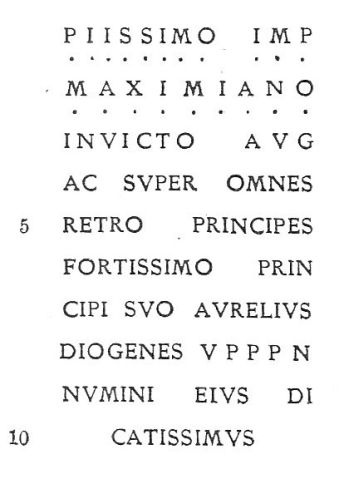
Inscription
[[Piissimo imp(eratori),]] / [[Maximiano,]] / invicto Aug(usto), / ac super omnes / (5) retro principes / fortissimo, prin/cipi suo, Aurelius / Diogenes, v(ir) p(erfectissimus), p(raeses) p(rovinciae) N(umidiae), / numini eius di/catissimus.
Inscription translation
To the most pious emperor, Maximinianus, unconquered Augustus and, above all earlier rulers, most powerful; Aurelius Diogenes, of perfectissimus rank, governor (praeses) of the province of Numidia, most devoted to his divine spirit, [set this up] to his emperor.
Bibliography
- Corpus Inscriptionum Latinarum; , VIII, no. 2574
Discussion
INSCRIPTION
In ten lines:
[[Piissimo imp(eratori),]] / [[Maximiano,]] / invicto Aug(usto), / ac super omnes / (5) retro principes / fortissimo, prin/cipi suo, Aurelius / Diogenes, v(ir) p(erfectissimus), p(raeses) p(rovinciae) N(umidiae), / numini eius di/catissimus.
'To the most pious emperor, Maximinianus, unconquered Augustus and, above all earlier rulers, most powerful; Aurelius Diogenes, of perfectissimus rank, governor (praeses) of the province of Numidia, most devoted to his divine spirit, [set this up] to his emperor.'
Letter height : 4 cm
The first two lines, with the name of the emperor Maximian have been deliberately erased, but apparently leaving some traces of the letters.
DESCRIPTION (from CIL)
Of this base, CIL gives no description other than its measurements: H 103, W 60 cm, depth unrecorded.
PROVENANCE AND CURRENT LOCATION
Our base was found in the military camp, behind the Praetorium. It may still be there.
HONORAND, AWARDER AND DATE
The honorand, Maximian, was Augustus from 286 to 305.
The awarder, Aurelius Diogenes (PLRE I, 256, Diogenes 7), was governor of Numidia between 286 and 293, providing the closest date for our dedication.
FURTHER DISCUSSION
Our base and another dedicated to Diocletian by the same awarder (LSA-2255) have the same formula. They must have been set up as a pair.
Maximian's name was probably removed at the same time as that of Diocletian on his paired base. If so, this will have been done by Christians eager to destroy the memory of men associated with paganism, rather than as an act of secular damnatio memoriae (though Maximian's memory did suffer a not very systematic damnatio after his revolt in 310).
Cite: Last Statues of Antiquity, LSA-2258 (Gabriel de Bruyn).