
LSA-226
Possible base for statue of Asclepiodotus, local notable and benefactor. Aphrodisias (Caria). Later fifth century.
Record details
Photographs
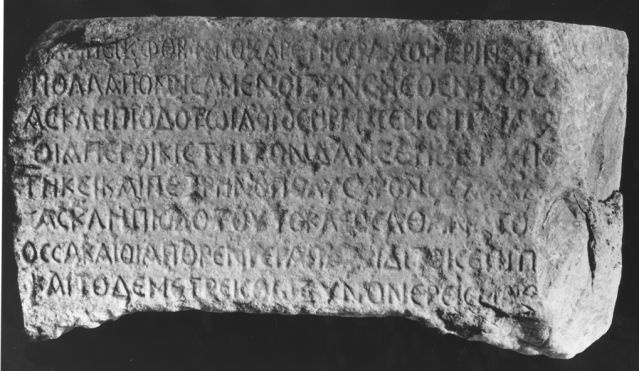
Inscription
[Λ]άμπει κ(αὶ) φθιμένοις ἀρετῆς φάος, οἳ περὶ πάτρη[ς] / πολλὰ πονησάμενοι ξυνὸν ἔθεντ' ὄφελ[ος]. / Ἀσκληπιοδότωι λόγος ἥρμοσεν, ὧι πόλις ἥ[δε] / οἷάπερ οἰκιστῆι τόνδ' ἀνέθηκε τύπο[ν]. dash / (5) Τήκει καὶ πέτρην ὁ πολὺς χρόνος: ἀλλ' ἀ[ρετάων] / Ἀσκληπιοδότου τὸ κλέος ἀθάνατον, / ὅσσα καὶ οἷα πόρεν γέρα πατρίδι τοῖς ἐπὶ π[ᾶσιν] / καὶ τόδε μετρείσθω ξυνὸν ἔρεισμα θό[λου].
Inscription translation
The light of virtue shines even for dead men, who, undertaking many labours for their country, established general benefits. The saying fits Asclepiodotus, for whom this city has dedicated this statue as for a founder.
Long time wears away even stone; but the fame of Asclepiodotus' virtues is immortal, the number and kind of privileges which he obtained for his country. In addition to all these, let this adjacent structure of the vaulted chamber be counted as well.
(Trans: C. Roueché)
Bibliography
- Roueché, C., Aphrodisias in Late Antiquity (Journal of Roman Studies Monograph 5), London 1989, no. 53
Discussion
INSCRIPTION
Verse inscription of four elegiac distichs laid out in eight lines:
[Λ]άμπει κ(αὶ) φθιμένοις ἀρετῆς φάος, οἳ περὶ πάτρη[ς] /
πολλὰ πονησάμενοι ξυνὸν ἔθεντ' ὄφελ[ος]. /
Ἀσκληπιοδότωι λόγος ἥρμοσεν, ὧι πόλις ἥ[δε] /
οἷάπερ οἰκιστῆι τόνδ' ἀνέθηκε τύπο[ν]. dash /
(5) Τήκει καὶ πέτρην ὁ πολὺς χρόνος: ἀλλ' ἀ[ρετάων] /
Ἀσκληπιοδότου τὸ κλέος ἀθάνατον, /
ὅσσα καὶ οἷα πόρεν γέρα πατρίδι τοῖς ἐπὶ π[ᾶσιν] /
καὶ τόδε μετρείσθω ξυνὸν ἔρεισμα θό[λου].
'The light of virtue shines even for dead men, who, undertaking many labours for their country, established general benefits. The saying fits Asclepiodotus, for whom this city has dedicated this statue as for a founder. Long time wears away even stone; but the fame of Asclepiodotus' virtues is immortal, the number and kind of privileges which he obtained for his country. In addition to all these, let this adjacent structure of the vaulted chamber be counted as well.'
(Trans: C. Roueché)
Letter height 3-4 cm.
DESCRIPTION
Rectangular base used its side. H: 54, W: 98, D: 51 cm. White marble.
The sides and back of the base preserve the form of a rectangular shaft base with elaborate projecting upper and lower mouldings. The mouldings on the front surface have been shaved down, and the verse inscribed along what had once been the vertical axis of the base. Probably what now is the viewer’s left side of the base was once the top.
PROVENANCE AND CURRENT LOCATION
It was built into a wall of a house on the eastern side of the old village of Geyre. The second epigram, which also appears in the Palatine Anthology, mentions a tholos.
HONORAND, AWARDER AND DATE
The honorand Asclepiodotus is also honoured in a funerary monument in the shape of a small pyramid atop a rectangular base (see under http://insaph.kcl.ac.uk/ala2004/inscription/eAla054.html). He was an important local man; who secured privileges for the city and perhaps built a round structure. He should probably be associated with the prominent and prosperous Asclepiodotus of Aphrodisias who became the father-in-law of the famous Asclepiodotus of Alexandria. Asclepiodotus of Alexandria was in Aphrodisias in the late fifth century.
The inscription was set up by the city of Aphrodisias (lines 3-4).
FURTHER DISCUSSION
This re-used base has been turned on its side and bears two different epigrams. The first epigram refers to the erection of a statue by the polis. It is difficult to imagine, however, that this block, used horizontally, with no cuttings preserved, ever supported a statue. Thus, this inscription may have been re-copied from elsewhere. This coincides well with the evidence of the second epigram.
The second epigram, which is recorded with a slight variation in line four in the Palatine Anthology, refers to a building. Both this version and the Palatine Anthology may have been re-copied from elsewhere. This elsewhere would seem to have been from near the tholos which it says Asclepiodotus built. Roueché postulates that this tholos is the round chamber of the Theatre Baths.
The block comes from the eastern, residential area of site. It is possible that both epigrams in honour of the same man may have been copied on this block and displayed in the private setting of the house of Asclepiodotus. The house of Asclepiodotus has been tentatively associated with the large, late-antique town house to the north of the Sebasteion (the so-called Atrium House) in which a series of shield portraits of philosophers was found; see, for example, LSA-206, LSA-207, LSA-210, LSA-211, LSA-212, LSA-213.
Cite: Last Statues of Antiquity, LSA-226 (J. Lenaghan).