
LSA-2261
Base for statue of Galerius, emperor, later re-used for a Caesar of the Constantinian dynasty. Lambaesis (Numidia). 305-337
Record details
Photographs
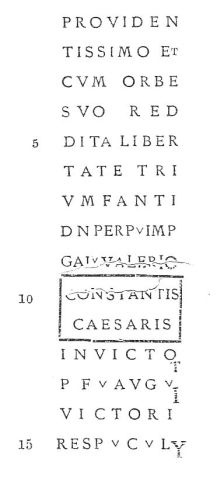
Inscription
Providen/tissimo e[t] / cum orbe / (4) suo red/dita liber/tate tri/umfanti, / d(omino) n(ostro), perp(etuo) imp(eratori), / [[Gal(erio) Valerio]] / (10) [[Maximiano]] / [[Iuniori]] Constantis / Caesaris (sic), / invicto, / p(io), f(elici), Aug(usto), / victori, / (15) res p(ublica) c(olonia) L(ambaesis).
Inscription translation
To the most prudent man, triumphing with his whole world at the return of freedom, our lord, eternal emperor, Galerius Valerius Constans (or Constantius) Caesar (replacing: Maximianus the Younger), unconquered, pious, fortunate Augustus, victor; the community (res publica) of the colony of Lambaesis [set this up].
Bibliography
- Corpus Inscriptionum Latinarum; , VIII, no. 18260
- Lepelley, C., Les cités de l'Afrique romaine au Bas-Empire, t. 2, Notices d'histoire municipale, Paris 1981, p. 422, no. 6
Discussion
INSCRIPTION
In 15 lines:
Providen/tissimo e[t] / cum orbe / (4) suo red/dita liber/tate tri/umfanti, / d(omino) n(ostro), perp(etuo) imp(eratori), / [[Gal(erio) Valerio]] / (10) [[Maximiano]] / [[Iuniori]] Constantis / Caesaris (sic), / invicto, / p(io), f(elici) Aug(usto), / victori, / (15) res p(ublica) c(olonia) L(ambaesis).
'To the most prudent man, triumphing with his whole world at the return of freedom, our lord, eternal emperor, Galerius Valerius Constans (or Constantius) Caesar (replacing: Maximianus the Younger), unconquered, pious, fortunate Augustus, victor; the community (res publica) of the colony of Lambaesis [set this up].'
In lines 9-11 the name of the original honorand has been erased, but remains partially legible. In lines 10-11, the original words 'Maximiano Iuniori' have been overwritten by 'Constantis Caesaris' (literally, 'of Constans Caesar' in the genitive, although the whole of the rest of the dedication is in the dative, as usual on statue inscriptions).
DESCRIPTION (from Poulle, 1883)
Limestone base: H 119, W 53, D 48 cm.
PROVENANCE AND CURRENT LOCATION
Found in the courtyard of the Capitolium, and now in the Tazoult museum.
HONORAND, AWARDER AND DATE
The first honorand, Galerius (full name, Caius Galerius Valerius Maximianus, here Caius Valerius Maximianus), was Caesar from 305 to 311. His name was probably removed from the inscription during Maxentius' tenure of Africa between 310 and 312. The identification of the later honorand, who replaced Galerius, is more problematic. Possibly it was Constans, youngest son of Constantine I and Caesar from 333 to 337 (and then Augustus from 337 to 350). However the use of the genitive for his name (see above, 'Inscription') is wholly anomalous, and it quite clear that the rededication was done with little care for detail, so other emperors whose names began with the letters 'Constant' are also possible candidates (Constantius I or II, Constantine I or II). Lepelly thought the second dedication was probably to Constantius I (Caesar 293-305, Augustus 305-6) set up posthumously by his son Constantine.
FURTHER DISCUSSION
The formula 'Providentissimo et cum orbe suo reddita libertate triumfanti' is very common in Lambaesis (see LSA-2163 dedicated to Constantine, LSA-2414 to Julian, and LSA-2415 possibly to Licinius).
Our base was re-used in 379-383 for a building inscription (see CIL VIII 18328, and Lepelley, 1981, p. 420, no. 8).
Cite: Last Statues of Antiquity, LSA-2261 (Gabriel de Bruyn).