
LSA-2262
Lost base for statue of Constantius I or Constantine I, emperor. Lambaesis (Numidia). 293-337
Record details
Photographs
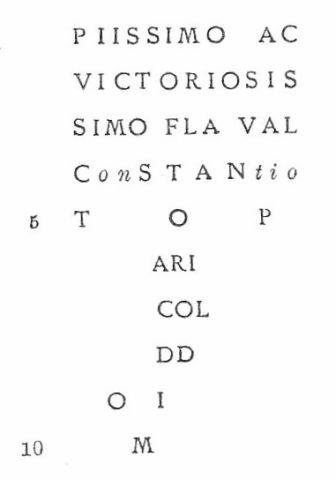
Inscription
Piissimo ac / victoriosis/simo Fla(vio) Val(erio) / C[on]stan[tio ?], / (5) T[---]O[---]P[---] / [---]ARI[---] / [---] col[onia(?) ---] / [---]DD[---] / [---]OI[---] / (10) [---]M[---].
Inscription translation
To the most pious and most victorious Flavius Valerius Constan..., ...the colony(?)...
Bibliography
- Corpus Inscriptionum Latinarum; , VIII, no. 18262
- Lepelley, C., Les cités de l'Afrique romaine au Bas-Empire, t. 2, Notices d'histoire municipale, Paris 1981, p. 423, n. 29
Discussion
INSCRIPTION
In ten lines:
Piissimo ac / victoriosis/simo Fla(vio) Val(erio) / C[on]stan[tio ?], / (5) T[---]O[---]P[---] / [---]ARI[---] / [---] col[onia(?) ---] / [---]DD[---] / [---]OI[---] / (10) [---]M[---].
To the most pious and most victorious Flavius Valerius Constan... , ... the colony(?)...'
The inscription was very badly damaged after the third line.
DESCRIPTION (from Poulle, 1883)
Base without plinth or crown, framed with mouldings ('Dé d'autel entouré de moulures'). There are no published measurements and no known image.
PROVENANCE AND CURRENT LOCATION
Our base was found in 1883 by Poulle in the courtyard of the Capitolium. It had been reused in an Arab-period wall next to one of the doors of the Capitolium. Poulle records that the stone was calcified, and fell to pieces when he moved it ('La pierre avait été calcinée et est tombée en morceaux, quand on l'a déplacée').
HONORAND, AWARDER AND DATE
The honorand's name as preserved in the inscription would suit either Constantius I (Caesar 293-305, Augustus 305-6, full name Marcus Flavius Valerius Constantius), or Constantine I (Caesar, then Augustus, 306-37, full name Flavius Valerius Aurelius Constantinus).
The name of the awarder is lost, but in common with most imperial statues in Africa, is likely to have been the city itself (and is supported by the recorded letters 'COL', perhaps from 'colonia'); however, since Lambaesis was a provincial capital, a dedication by a provincial governor, or other imperial official, is also possible.
The formula 'Piissimo ac...' is common in Lambaesis in the late 3rd century and at the very beginning of the 4th century (see LSA-2253, LSA-2254, LSA-2255, LSA-2257 and LSA-2258), which lends some support to the honorand being Constantius I, rather than Constantine.
Discussion references
- Recueil des notices et mémoires de la société archéologique de la province de Constantine, Constantine, 1876-1877, 1883, XXII, p. 385, no. 135
Cite: Last Statues of Antiquity, LSA-2262 (Gabriel de Bruyn).