
LSA-2263
Base for statue of Constantine I, emperor. Lambaesis (Numidia). 307-324
Record details
Photographs
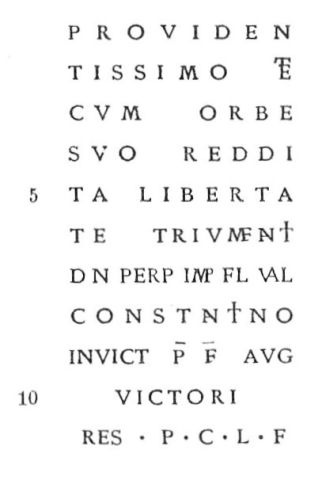
Inscription
Providenti/ssimo et / cum orbe / (4) suo reddi/ta liberta/te triump(h)ant(i), / d(omino) n(ostro), per(petuo) imp(eratori), Fl(avio) Val(erio) / Constantino, / invicto, p(io), f(elici) Aug(usto), / (10) victori, / res pu(blica) c(oloniae) L(ambaesitanae) f(ecit).
Inscription translation
To the most prudent man, triumphing with his whole world at the return of freedom, our lord, eternal emperor, Flavius Valerius Constantinus, unconquered, pious, fortunate Augustus, victor; the commonwealth (res publica) of the colony of Lambaesis made [this].
Bibliography
- Corpus Inscriptionum Latinarum; , VIII, no. 2721
- Lepelley, C., Les cités de l'Afrique romaine au Bas-Empire, t. 2, Notices d'histoire municipale, Paris 1981, p. 423, no. 8
Discussion
INSCRIPTION
In eleven lines:
Providenti/ssimo et / cum orbe / (4) suo reddi/ta liberta/te triump(h)ant(i), / d(omino) n(ostro), per(petuo) imp(eratori), Fl(avio) Val(erio) / Constantino, / invicto, p(io), f(elici) Aug(usto), / (10) victori, / res pu(blica) c(oloniae) L(ambaesitanae) f(ecit).
'To the most prudent man, triumphing with his whole world at the return of freedom, our lord, eternal emperor, Flavius Valerius Constantinus, unconquered, pious, fortunate Augustus, victor; the commonwealth (res publica) of the colony of Lambaesis [set this up].'
Letter height: 5 cm
DESCRIPTION (from CIL)
Of this base, CIL gives no description, other than its measurements: H 100, W 51 cm, depth unrecorded.
PROVENANCE AND CURRENT LOCATION
Our base was found in the courtyard of the Capitolium. It is now in Tazoult, in the museum.
HONORAND, AWARDER AND DATE
The honorand, Constantine I, was Augustus from 306 to 337.
The awarder was the city, as usual for imperial statues in Africa.
Although Constantine was proclaimed Augustus in York in 306, he was not recognised as such in Africa before 307. The triumphant opening formula of our inscription - 'Providentissimo et cum orbe suo reddita libertate triumphanti' - would normally be associated on a Constantinian base with the emperor's victory over Maxentius in 312; however this particular formula is very common in Lambaesis and cannot be associated with any specific event (see LSA-2161 to Galerius, LSA-2414 to Julian, and LSA-2415 possibly to Licinius). A more reliable dating criterion is the use of invictus, which, because of its pagan connotations, Constantine replaced with victor in 324 (Lassère, 2005, p. 607). Our base can therefore be dated to between 307 and 324.
Lepelley suggests that this base and another dedicated to Licinius, which has the same formula and dimensions, were set up as a pair (see LSA-2415). If so, our base must have been erected between 312 and 323, the dates when Licinius' rule in the East was recognised in Africa. This association is possible (and supported by the two bases' similar dimensions), but is not certain, since (as noted above) the formula is common in Lambaesis.
Discussion references
- Lassère, J.-M., Manuel d'épigraphie romaine, Paris, 2005, p. 607
Cite: Last Statues of Antiquity, LSA-2263 (Gabriel de Bruyn).