
LSA-2264
Base for statue of Constantine I, emperor. Lambiridi (Numidia). 307-324
Record details
Photographs
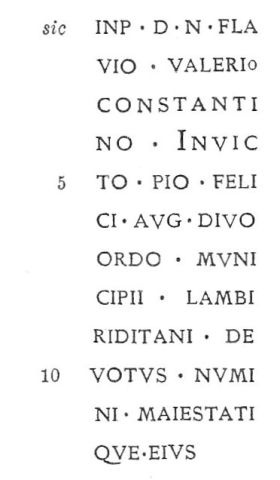
Inscription
Inp(eratori) (sic), d(omino) n(ostro) Fla/vio Valerio / Constanti/no, invic/to, pio, feli/ci Aug(usto), divo, / (7) ordo muni/cpii (sic) Lambi/riditani, de/votus numi/ni maiestati/que eius.
Inscription translation
To the emperor, our lord Flavius Valerius Constantinus, unconquered, pious, fortunate Augustus, divine; the council (ordo) of the city (municipium) of the Lambiriditani, devoted to his divine spirit and majesty, [set this up].
Bibliography
- Corpus Inscriptionum Latinarum; , VIII, no. 4414
- Lepelley, C., Les cités de l'Afrique romaine au Bas-Empire, t. 2, Notices d'histoire municipale, Paris 1981, p. 425, n. 6
Discussion
INSCRIPTION
In twelve lines:
Inp(eratori) (sic), d(omino) n(ostro) Fla/vio Valerio / Constanti/no, invic/to, pio, feli/ci Aug(usto), divo, / (7) ordo muni/cpii (sic) Lambi/riditani, de/votus numi/ni maiestati/que eius.
'To the emperor, our lord Flavius Valerius Constantinus, unconquered, pious, fortunate Augustus, divine; the council (ordo) of the city (municipium) of the Lambiriditani, devoted to his divine spirit and majesty, [set this up].'
DESCRIPTION
There are no published descriptions or measurements of this base, and no published image.
PROVENANCE AND CURRENT LOCATION
The inscription was set up in Lambiridi (lines 7-9; http://www.trismegistos.org/place/18540). However, there is no published record of the precise findspot or present location.
HONORAND, AWARDER AND DATE
The honorand, Constantine I, was Augustus from 306 to 337.
The awarder was the city, as usual for imperial statues in Africa
Although Constantine was proclaimed Augustus in York in 306, his title was only recognised in Africa in 307. In 324, he replaced invictus (unconquered), which appears on our inscription, with victor (Lassère, 2005, 607). This dedication can therefore be dated to the period 307-24.
While divo, divine, would normally mean the dedication was posthumous (and therefore later than 337), in this case the word is probably being used loosely, for a living emperor, in an inscription which contains other minor errors.
Discussion references
- Lassère, J.-M., Manuel d'épigraphie romaine, Paris, 2005, p. 607
Cite: Last Statues of Antiquity, LSA-2264 (Gabriel de Bruyn).