
LSA-2270
Base for statue of Constantius I, emperor. Thibilis (Numidia). 293-305
Record details
Photographs
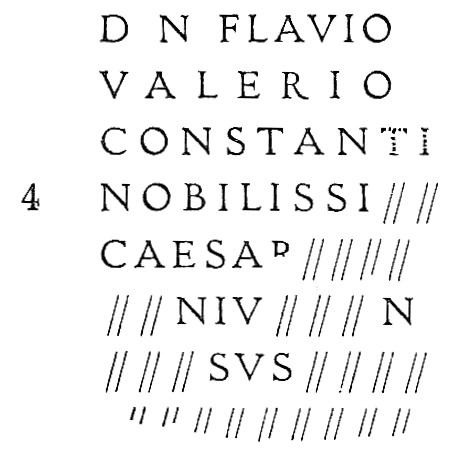
Inscription
D(omino) n(ostro), Flavio / Valerio / Constanti[o], / nobilissi[mo] / (5) Caesar[i --- / ---]nius[---]n / [---]sus[---
Inscription translation
To our lord, Flavius Valerius Constantius, most noble Caesar...
Bibliography
- Lepelley, C., Les cités de l'Afrique romaine au Bas-Empire, t. 2, Notices d'histoire municipale, Paris 1981, p. 481, no. 2
- Pflaum, H., Inscriptions Latines de l'Algérie, T. 2: Inscriptions de la confédération cirtéenne, de Cuicul et de la tribu des suburbures, vol. 2, Algiers 1976, no. 4670
Discussion
INSCRIPTION
The traces of eight lines of inscription survive:
D(omino) n(ostro), Flavio / Valerio / Constanti[o], / nobilissi[mo] / Caesar[i --- / ---]nius[---]n / [---]sus[---
'To our lord, Flavius Valerius Constantius, most noble Caesar ...'
Letter height: 4 cm
DESCRIPTION (from Pflaum)
Marble base, broken at the base ('brisée en bas'): H 79, W 42, depth unrecorded.
PROVENANCE AND CURRENT LOCATION
Our base was found by Poulle in 1890 in the forum. There is no recent published record of its location.
HONORAND, AWARDER AND DATE
The honorand, Constantius I, was Caesar from 293 to 305.
The awarder's name is lost, but, in common with the vast majority of imperial statues in Africa at this date, is very likely to have been the city itself.
Discussion references
- Recueil des notices et mémoires de la société archéologique de la province de Constantine, Constantine, 1890-1, XXVI, p. 338, no. 38
Cite: Last Statues of Antiquity, LSA-2270 (Gabriel de Bruyn).