
LSA-2275
Base for statue of Valentinian I, emperor. Thibilis (Numidia). 364-375
Record details
Photographs
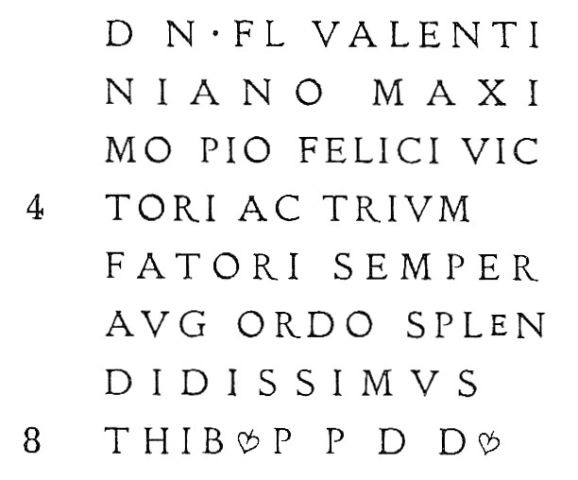
Inscription
D(omino) n(ostro), Fl(avio) Valenti/niano, maxi/mo, pio, felici, vic/tori ac trium/fatori, semper / (6) Aug(usto), ordo splen/didissimus / Thib(ilitanorum), (ivy leaf) p(ecunia) p(ublica), d(ecreto) d(ecurionum). (ivy leaf)
Inscription translation
To our lord, Flavius Valentinianus, the greatest, pious, fortunate, victorious and triumphant, forever Augustus; the most splendid council (ordo) of the Thibilitani [set this up] with public funds, by decree of the councillors.
Bibliography
- Lepelley, C., Les cités de l'Afrique romaine au Bas-Empire, t. 2, Notices d'histoire municipale, Paris 1981, p. 483, no. 8
- Pflaum, H., Inscriptions Latines de l'Algérie, T. 2: Inscriptions de la confédération cirtéenne, de Cuicul et de la tribu des suburbures, vol. 2, Algiers 1976, no. 4675
Discussion
INSCRIPTION
In eight lines:
D(omino) n(ostro), Fl(avio) Valenti/niano, maxi/mo, pio, felici, vic/tori ac trium/fatori, semper / (6) Aug(usto), ordo splen/didissimus / Thib(ilitanorum), (ivy leaf) p(ecunia) p(ublica), d(ecreto) d(ecurionum). (ivy leaf)
To our lord, Flavius Valentinianus, the greatest, pious, fortunate, victorious and triumphant, forever Augustus; the most splendid council (ordo) of the Thibilitani [set this up] with public funds, by decree of the councillors.
Letter height: 6 - 5 cm
DESCRIPTION (from Pflaum)
Rectangular marble base: H 105, W 62 cm, depth unrecorded.
PROVENANCE AND CURRENT LOCATION
Our base was found in the forum by Mercier in 1892. There is no recent published record of its location.
HONORAND, AWARDER AND DATE
Valentinian I was Augustus from 364 to 375.
The awarder, as usual with imperial statues in Africa, was the city, in this case specifically the council (ordo).
Our base and one dedicated to Gratian (LSA-2276) are very similar in their wording. It is quite possible that they were set up as a pair, which would narrow the dating of our inscription to 367-75. However, a very similar formula is found on a base to Julian of the years 361-3 (LSA-2274), which suggests that the wording was commonplace in Thibilis.
Discussion references
- Recueil des notices et mémoires de la société archéologique de la province de Constantine, Constantine, 1892, XXVII, p. 253, no. 3
Cite: Last Statues of Antiquity, LSA-2275 (Gabriel de Bruyn).