
LSA-2276
Base for statue of Gratian, emperor. Thibilis (Numidia). 367-383
Record details
Photographs
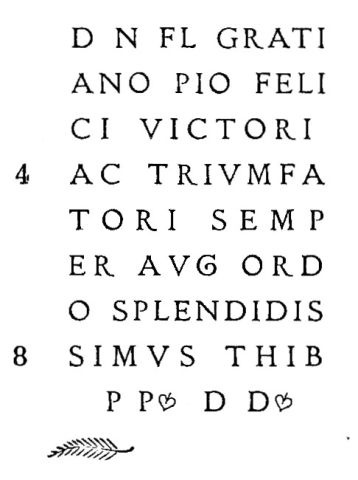
Inscription
D(omino) n(ostro), Fl(avio) Grati/ano, pio, feli/ci, victori / (4) ac triumfa/tori, semp/er Aug(usto), ord/o splendidis/simus Thib(ilitanorum), / p(ecunia) p(ublica) (ivy leaf) d(ecreto) d(ecurionum) (ivy leaf). / (palm branch)
Inscription translation
To our lord, Flavius Gratianus, pious, fortunate, victorious and triumphant, forever Augustus; the most splendid council (ordo) of the Thibilitani [set this up] with public funds, by decree of the councillors.
Bibliography
- Lepelley, C., Les cités de l'Afrique romaine au Bas-Empire, t. 2, Notices d'histoire municipale, Paris 1981, p. 483, no. 9
- Pflaum, H., Inscriptions Latines de l'Algérie, T. 2: Inscriptions de la confédération cirtéenne, de Cuicul et de la tribu des suburbures, vol. 2, Algiers 1976, no. 4676
Discussion
INSCRIPTION
In nine lines of text:
D(omino) n(ostro), Fl(avio) Grati/ano, pio, feli/ci, victori / (4) ac triumfa/tori, semp/er Aug(usto), ord/o splendidis/simus Thib(ilitanorum), / p(ecunia) p(ublica) (ivy leaf) d(ecreto) d(ecurionum). (ivy leaf) / (palm branch)
'To our lord, Flavius Gratianus, pious, fortunate, victorious and triumphant, forever Augustus; the most splendid council (ordo) of the Thibilitani [set this up] with public funds, by decree of the councillors.'
Letter height: 5 cm
DESCRIPTION (from Pflaum)
Rectangular marble base, the inscription framed within a moulding: H 93, W 49 cm, depth unrecorded.
PROVENANCE AND CURRENT LOCATION
Our base was found in the forum by Mercier in 1892. There is no recent published record of its location.
HONORAND, AWARDER AND DATE
Gratian was Augustus from 367 to 383.
The awarder, as usual with imperial statues in Africa, was the city, in this case specifically the council (ordo).
Our base and one dedicated to Valentinian I (LSA-2275) are very similar in their wording. It is quite possible that they were set up as a pair, which would narrow the dating of our inscription to 367-75. However, a very similar formula is also found on a base to Julian of the years 361-3 (LSA-2274), which suggests that the wording was commonplace in Thibilis.
Discussion references
- Recueil des notices et mémoires de la société archéologique de la province de Constantine, Constantine, 1892, XXVII, p. 253, no. 4
Cite: Last Statues of Antiquity, LSA-2276 (Gabriel de Bruyn).