
LSA-2277
Base for posthumous statue of Constantius I, emperor. Tubunae (Numidia). 312-337
Record details
Photographs
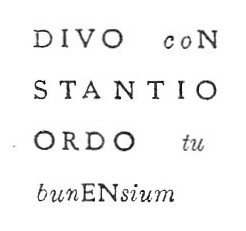
Inscription
Divo [Co]n/stantio, / ordo [Tu]/[bun]en[sium].
Inscription translation
To the divine Constantius; the city council (ordo) of Tubunenses [set this up].
Bibliography
- Corpus Inscriptionum Latinarum; , VIII, no. 4484
- Lepelley, C., Les cités de l'Afrique romaine au Bas-Empire, t. 2, Notices d'histoire municipale, Paris 1981, p. 487, n. 3
Discussion
INSCRIPTION
In four lines:
Divo [Co]n/stantio, / ordo [Tu]/[bun]en[sium].
'To the divine Constantius; the city council (ordo) of the Tubunenses [set this up].'
The wording is exceptionally laconic, but does reproduce the essential characteristics of a statue dedication: an honorand in the dative, and an awarder in the nominative. Perhaps for an emperor now a god (divus) it was sufficient to state his divinity and principal name, omitting the long list of names and titles needed for a living ruler.
DESCRIPTION (from CIL)
Of this inscribed block CIL gives no description, other than its measurements: H 100, W 46 cm, depth unrecorded. These are measurements suitable for a statue base.
PROVENANCE AND CURRENT LOCATION
Found 2 kilometres north of Tobna. There is no record of its precise findspot or present location.
HONORAND, AWARDER AND DATE
The honorand, Constantius I, was Caesar from 293 to 305, and Augustus from 305 until his death in 306.
The awarder was the city, specifically its council (ordo).
Since he is termed 'divus, divine' in the inscription, the base was certainly erected after Constantius' death.
A date after his son, Constantine, became effective ruler of Africa in 312 is almost certain (since it is hard to imagine another ruler honouring a dead emperor in this way); while a date fairly early in Constantine's reign (when it was important to stress his descent from Constantius) is very likely.
Cite: Last Statues of Antiquity, LSA-2277 (Gabriel de Bruyn).