
LSA-228
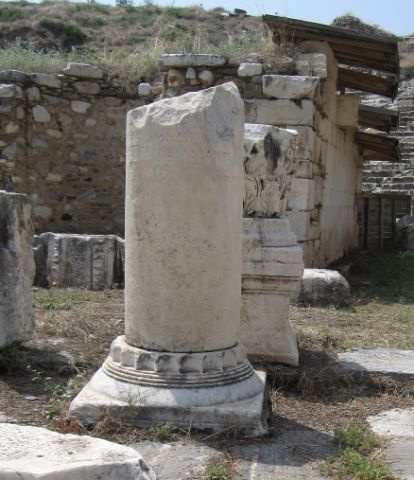
Columnar base for statue, probably of a governor. Aphrodisias (Caria). Fifth century.
Record details
Photographs
Inscription
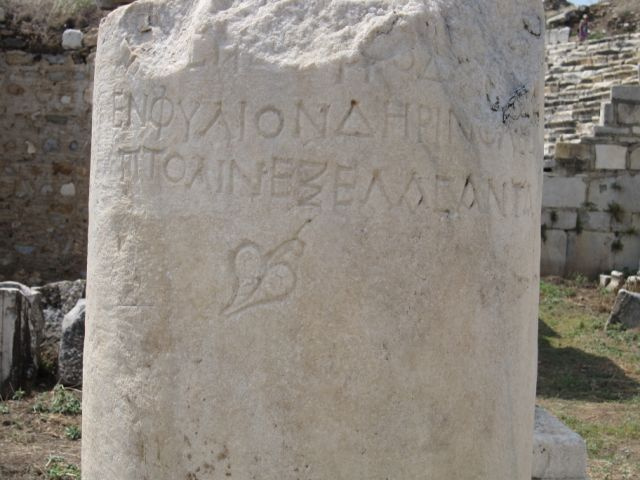
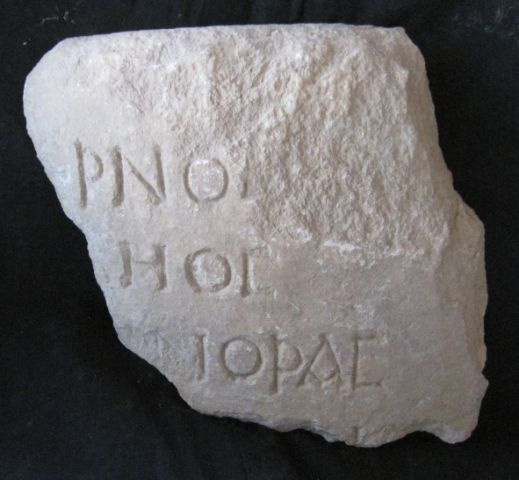
[... c. 13 ...] ἔρνος / [... c. 12 ...]ληοσ / [... c. 12 ...]ινορασ / [...] / (5) [...] / λ[..]σησ Ἀφροδ[ίτη]ν / ἐνφύλιον δῆριν ὀλεσί /πτολιν ἐξελάσαντα leaf .
Inscription translation
[...] offspring [...] Aphrodite, (he who) drove out city-destroying civil strife.
(Trans: C. Roueché)
Bibliography
- Roueché, C., Aphrodisias in Late Antiquity (Journal of Roman Studies Monograph 5), London 1989, 104-105, no. 64, pl. 16
Discussion
INSCRIPTION
Fragmentarily preserved in eight lines:
[... c. 13 ...] ἔρνος / [... c. 12 ...]ληοσ / [... c. 12 ...]ινορασ / [...] / (5) [...] / λ[..]σησ Ἀφροδ[ίτη]ν / ἐνφύλιον δῆριν ὀλεσί / πτολιν ἐξελάσαντα leaf .
'[...] offspring [...] Aphrodite, (he who) drove out city-destroying civil strife.'
(Trans: C. Roueché)
DESCRIPTION (Object)
Fragmentary columnar base on re-used capital. Column H: 121, Diam: 51-54 cm. Fragment of column H: 25.5, W: 26, D: 8.5 cm. Base-capital H: 31.5 , W: 87, D: 87 cm. White marble.
Lower element. This is a re-used Doric capital. It has an abacus, lower abacus, echinus, necking rings, and the beginning of a fluted shaft.
Inscribed shaft. This is a smoothly worked column shaft which is narrower than the lower element. A fragment bearing the ends of three lines is preserved separately. The text inscription ends 86 cm from the bottom of the shaft and the leaf is eight centimetres below that (74 cm from the bottom of the shaft).
PROVENANCE AND CURRENT LOCATION
Both the column shaft and its base, the re-used Doric column were found in 1972 in situ in front of the northern most column of the western stoa of the Tetrastoon. A small fragment of the inscribed shaft was found in 1973 was found 20 cm above the pavement in the northeast corner of the Tetrastoon.
HONORAND AND DATE
The names of honorand and awarder are lost. The reference to the honorand's driving out 'city-destroying civil strife' (lines 7-8) possibly refers to a man with authority to execute justice, possibly a governor.
There is no secure date for the inscription. Roueche suggests a fifth century date on the basis of the writing style and ivy leaf. The ivy leaf appears on other bases from the same series in the Tetrastoon; see Palmatus (LSA-199) and Vitianus, (LSA-229). The strife, of which he ridded the city, cannot be related to any specific moment.
Cite: Last Statues of Antiquity, LSA-228 (J. Lenaghan).