
LSA-2280
Base for statue, probably of Valens, emperor. Balboura (Lycia). 375-378.
Record details
Photographs
Inscription
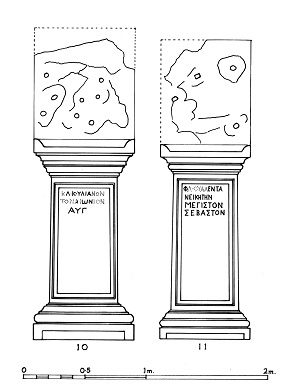
Φ [λ(άουιον) Οὐά]λε?ν?τ?α v. / νεικητὴν v. / μέγιστον v. / Σεβαστόν
Inscription translation
Fl(avius) Valens, victor, greatest Augustus.
Bibliography
- Corpus Inscriptionum Graecarum; , vol. III no. 4380 k
- Cagnat, R. (ed.), Inscriptiones Graecae ad res Romanas pertinentes, Paris 1906-, vol. III no. 469
- Le Bas, P. and W.H. Waddington, Inscriptions grecques et latines recueillies en Grèce et en Asie Mineure, vol. III, Paris 1870, p. 304 no. 1230
- Milner, N.P. 'Balboura: Three Fourth Century Imperial Statue Bases', , no. 11, fig. 13.22-23
Discussion
INSCRIPTION
In four lines:
Φ [λ(άουιον) Οὐά]λε?ν?τ?α v. / νεικητὴν v. / μέγιστον v. / Σεβαστόν
'To Flavius Valens, victor, greatest Augustus'
Letter height 4 - 4.5 cm.
We reproduce the text as communicated to us by N. P. Milner. Hoskyn 1842, the first editor of the text, read lines 1-2 as follows: --- NA / ΙΗΡΗΙΗΝ; he was followed in this reading by the Corpus Inscriptionum Graecarum. Waddington & Le Bas 1870 read ... ν / ἀ[ρχ]ιερ[έα] (?) / μέγιστο[ν] / Σεβαστόν, followed by Cagnat 1906. The imperial name is only very partially preserved, so some doubts as to its correct reading must remain (see below, 'Honorand and Date').
DESCRIPTION (from Milner, and the photograph and drawing given us)
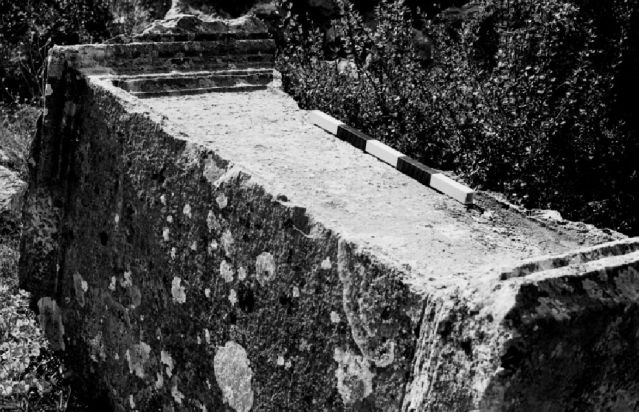
Rectangular limestone base moulded at top and bottom: H 160, W 55, D 78 cm. The top moulding is damaged, the lower left corner is chipped, and the right panel is broken off. On the top face, there are several holes, the traces of fixings for a bronze statue. Our inscription is carved over an erased earlier one of about 10 lines of which traces are visible in the lower part of the epigraphic field. The surface is very weathered, rendering the inscription difficult to read.
PROVENANCE AND CURRENT LOCATION
The inscription was first recorded by Hoskyn in 1840/1 'at the ruins at Katra, near Tremili’, that is the site of ancient Balboura. It was re-discovered by Milner on the east side of the agora lying next to the inscribed base to Julian (LSA-2279), where it remains.
HONORAND AND DATE
There is some doubt as to the name of the honorand, because of the poor condition of the inscription, but it appears to have been Valens (full name Flavius Valens, as apparently here), Augustus 364-78. He took the title of 'maximus Augustus' (Greek, μέγιστος Σεβαστος, lines 3-4) after the death of his brother and co-emperor Valentinian I in 375 (Kienast 1990, 330). This provides a date of 375-8 for our inscription.
FURTHER DISCUSSION
At Balboura there are two further imperial inscriptions from the mid-4th century, another one to Valens, probably dating from earlier in his reign (LSA-2281), and one to Julian (LSA-2279).
ACKNOWLEDGEMENT
We are grateful to N. P. Milner who communicated his unpublished reading of the inscription to us.
Discussion references
- Hoskyn, Rd., Narrative of a Survey of Part of the South Coast of Asia Minor; And of a Tour into the Interior of Lycia in 1840-1; Accompunied by a Map, Journal of the Royal Geographical Society of London 12, 1842, 143-61, p. 161 no. 10
Cite: Last Statues of Antiquity, LSA-2280 (Ulrich Gehn).