
LSA-2282
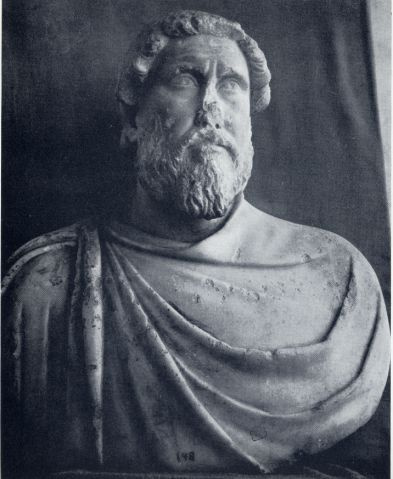
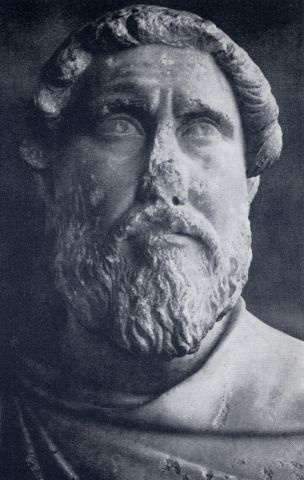
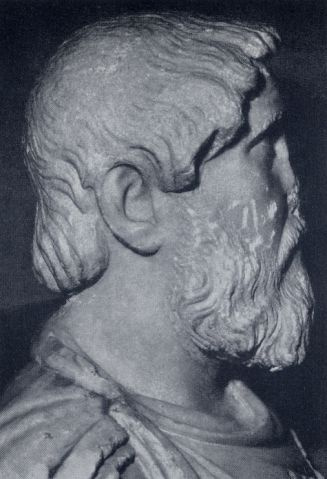
Portrait bust of bearded man wearing chlamys. From Sebastopolis (Helenopontus). Late fourth to early fifth century.
Record details
Photographs
Bibliography
- Inan, J. and E. Rosenbaum, Roman and Early Byzantine Portrait Sculpture in Asia Minor, Oxford 1966, 106-107, no. 107, pls. 183.1-2, 184.1 (third quarter of fifth century)
Discussion
DESCRIPTION (Object)
Over life-size bust. H: 61, W: 51 cm. H (chin to crown): 26.5 cm. Coarse-grained white marble
The head and bust are worked from the same piece of marble. The fibula on the right shoulder has broken off.
The back of the bust has been hollowed out but there is no spine, though the central area is said to have been worked more roughly. It was attached to a pedestal by a dowel which is still extant in the bottom surface. The pupils of the eyes are rendered as heavy crescent shapes. The irises are not indicated. There is no use of the drill in the hair.
PROVENANCE
From ancient Sebastopolis.
DESCRIPTION (Subject)
The portrait bust shows a man dressed in a chlamys and tunic. The chlamys was fastened on the right shoulder by a fibula. Most of the folds of the chlamys loop from the fibula to the left shoulder; a thicker rounder fold falls vertically from the fibula.
The man has a long face with a broad jaw line. His brow is marked by a series of horizontal folds and deep vertical creases above the root of the nose.
He wears a full beard and moustache. The beard extends beyond the chin and has a natural wave. The hair is brushed forward and curls under itself, creating more volume, around the brow.
DATE
The fashion style of beard and hair and clothing choice are similar to those of the portrait of Oecumenius LSA-150 from Aphrodisias (and LSA-869 from Cyprus). Oecumenius, identified by his base at Aphrodisias, should be dated to the late fourth or early fifth century Such a date seems well-confirmed by the Obelisk of Theodosius in Istanbul on which this fashion style is attested.
Examples of similarly styled portraits are LSA-178from Aphrodisias, LSA-320 from Smyrna, LSA-445 from Tabai, and LSA-450 from Asia Minor.
A similar bust format can be seen in LSA-205 from Aphrodisias.
Discussion references
- Gehn, U., Ehrenstatuen in der Spätantike. Chlamydati und Togati, Wiesbaden 2012, 451-3 cat. no. O 33 pl. 21
Cite: Last Statues of Antiquity, LSA-2282 (J. Lenaghan).