
LSA-2287
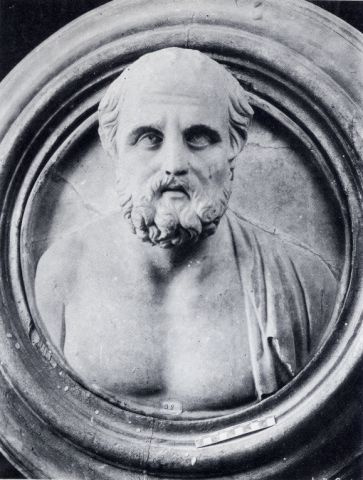
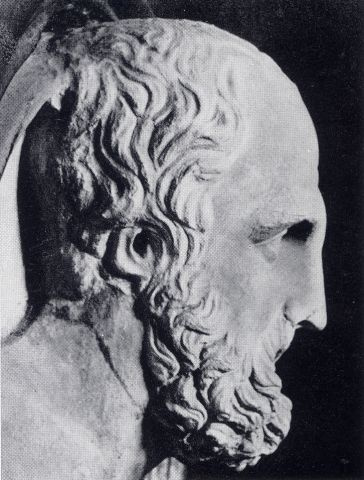
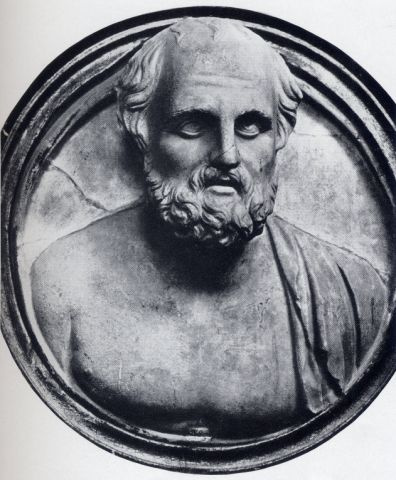
Shield portrait of balding and bearded man with straggly locks on brow. Italy. Fourth century?
Record details
Photographs
Bibliography
- Calza, R. et al. (eds.), Antichità di Villa Doria Pamphilj, Rome 1977, 269-270, no. 326, pl. 74
- Danguillier, C., Typologische Untersuchungen zur Dichter- und Denkerikonographie in römischen Darstellungen von der mittleren Kaiserzeit bis in die Spätantike, Oxford 2001, 250, no. 1 (Hadrianic to early Antonine)
- Richter, G.M.A., The Portraits of the Greeks, London 1965, II, 214, figs. 1382-3 (dubious Aeschines)
Discussion
DESCRIPTION (Object)
Shield portrait. H: 53 cm. Marble (Luni?).
The tip of the nose, the left eyebrow, and part of the background are modern restorations . The head was separated at some point from the bust but belongs to it. The circular wood frame is not ancient.
The pupils are probably circular holes. The photograph makes it difficult to judge, and only Calza makes reference to them, ‘l’incavo della pupilla aumenta l’intensità dell’espressione.’ The irises appear to be engraved with a flat chisel and do not touch the lower lid. The hair is rendered with a flat chisel.
PROVENANCE
The exact provenance is unknown. It was however already recorded in the inventory of 1709 in the Pamphili-Doria collection. It is always referred to as the pendant to LSA-2440.
DESCRIPTION (Subject)
The shield portrait shows a man with a full beard and a particular balding brow; it features only three long sparse strands on that come forward. He wears only a himation over his left shoulder.
The straggly hair is fuller around the ears which are mainly covered. The beard and moustache are heavy and made of thick curling locks. There is a slight part in the beard above the chin.
The tall brow has two creases and bulges above the deep-set eyes. The cheekbones are widely-spaced. The lower part of the face recedes.
HONORAND
The form of the monument, the clothing, and the fashion style of the honorand suggest that a Greek cultural figure is intended. It borrows the straggly locks on the bald brow from the so-called Rieti Euripides type or the portraits of Aristotle. The facial structure relates to the portraits of Aeschines and even Thucydides. Richter suggested tentatively that it represented Aeschines; this identification was in part encouraged by the fact that it is now a pendant to a shield portrait of Demosthenes LSA-2440, which probably came from the same context.
DATE
The lack of published images makes this portrait of an intellectual (already a chronologically difficult genre) hard to place. Danguillier in fact thought that it was Hadrianic or early Antonine because of the lack of significant drill work. The lack of drill work combined with the emphatic eyes, however, could equally be understood to indicate a fourth-century date (see LSA-2537.
Two considerations suggest that this might be the case. First, it is now a pendant to a similarly-sized shield portrait of Demosthenes LSA-2440 which is probably fourth-century. Images of intellectuals and heros of the Greek world were popular in shield portraits in late antiquity, and these two examples now in the Doria Pamphili collection might well belong with several other found in or around Rome; see the Menander LSA-2109<k, the Bornova-Heidelberg type LSA-2441, and Socrates LSA-2511.
Second, the absence of a clear model and the slightly frozen aspect of the rendering are more common among later images of cultural figures (see for example LSA-213 ). It is worth noting here that the most distinctive aspect of the portrait, the locks on the bald brow, appear on a fourth or fifth century portrait bust at Aphrodisias, LSA-203, whose hair behaves similarly around the ears.
Cite: Last Statues of Antiquity, LSA-2287 (J. Lenaghan).