
LSA-2289
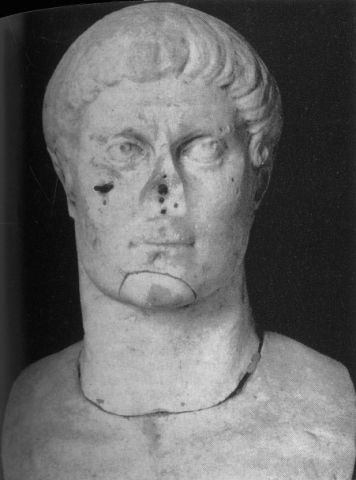
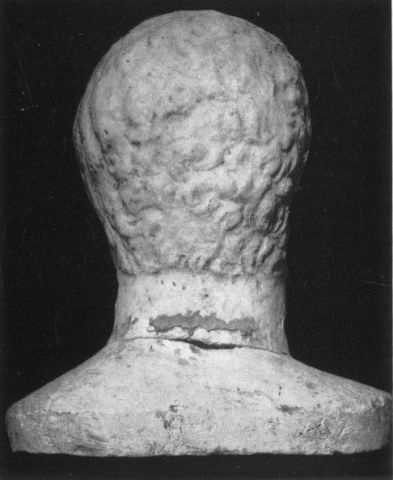
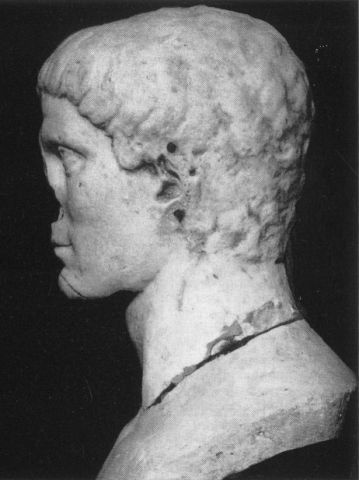
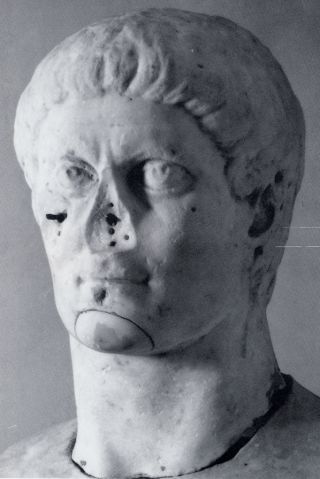
Portrait head of Constantine. From Italy? Early fourth century.
Record details
Photographs
Bibliography
- Giuliano, A. 'Augustus-Constantinus', Bollettino d'Arte 69, Milan 1991, 7, figs. 9-11
- Giuliano, A. 'Augustus-Constantinus', Roman Portraits. Artistic and Literary, Mainz 1997, 31, fn. 4, pl. 6.2
Discussion
DESCRIPTION (Object)
Over life-size head set into alien bust. H (of ancient head): 38.6 cm. Fine-grained white marble.
The head is cut around the base of the neck. The left ear, area around the left cheekbone, and nose were restored; the restorations, attached by iron pins, are now missing. The chin is also a restoration and still adheres.
The head has been re-cut. The full curly hair, preserved at the sides and back of the head, belong to an earlier use. The use of the head as a separately worked object probably belongs its fourth century deployment, as do the brow over the hair and the markings of the eye.
The hair over the brow is worked with a flat chisel. The irises are engraved and three-quarters of circles. The pupils are U-shaped.
PROVENANCE
The head is now in a private collection in England. The restorations, consisting of iron pins and dressed surfaces with bands of anathyrosis, are typical of the 17th to 19th centuries. They suggest to this author that the object was acquired in Italy probably in the ‘Grand Tour’ period.
DESCRIPTION (Subject)
The re-cut head turns to its left, and in its second use represents Constantine the Great. He is shown as a mature beardless man with a fringe of C-shaped locks that turn inwards.
He has a broad brow, widely-spaced protruding cheekbones, close-set eyes, and a square jaw. The brow has one horizontal furrow and two vertical creases over the root of the nose. The mouth is thin-lipped and with a marked depression separating it from the chin below.
Only the locks of hair across the brow reproduce those standard to portraits of Constantine. They are thick, brushed forward, and converge over the centre of the brow.
DATE
The head follows the most portrait model of the Emperor Constantine (see, LSA-558 or LSA-834), which was probably created for Constantine’s quinquennalia since the type appears on coins first in 310.
Cite: Last Statues of Antiquity, LSA-2289 (J. Lenaghan).