
LSA-2291
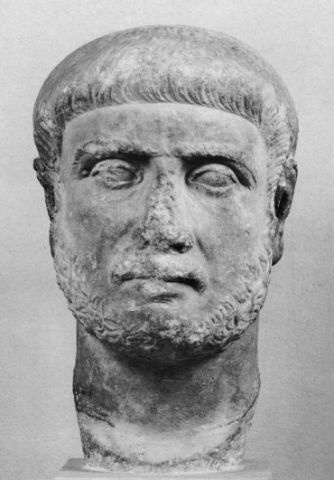
Portrait head of bearded man. Athens? Later fourth century
Record details
Photographs
Bibliography
- Datsoule-Satvride, A., Romaika Portraita sto Ethniko Archaiologiko Mouseio tes Athenas, Athens 1985, p. 86 no. Θ 334 pl. 124-5
- Datsoule-Stavride, A., Hysteroromaika Portraita 2ou - 4ou m(eta) Ch(ristou) Aiona sto Ethniko Archaiologiko Mouseio Athenon, Archaiologike Ephemeris 1981, 127-38, Athens 1983, p. 136 no. Θ 334 pl. 50 d
Discussion
DESCRIPTION (Object)
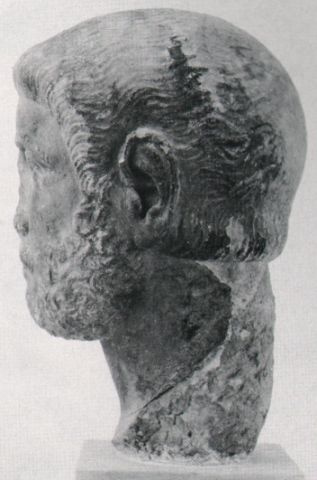
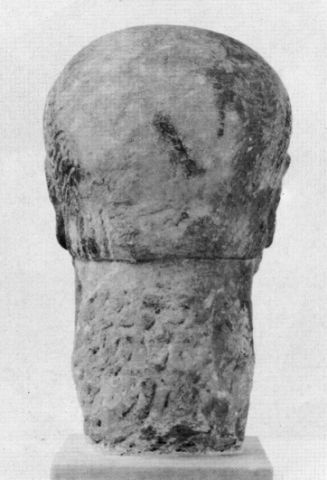
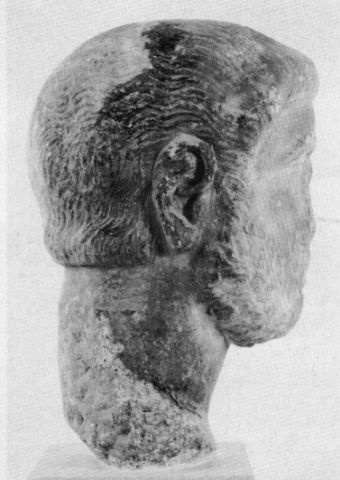
Worked for insertion; there is no published information on the material (marble?). H (overall) 30.6, (head) 23.3; W 18.7; D 20.7 cm (measurements from Datsoule-Stavride 1981, 136 n. 2). Nose, lips, right eyebrow and eye are chipped. Datsoule-Stavride notes traces of blue and red colour on the surface. At the back, a large hack is probably from the impact of a modern tool; the surface surrounding that hack appears extensively flaked from the published photos. At the left back a layer of stone is flaked off just below the rim of the hair. The dressing of the neck for the insertion is done with a rough point. It reaches high up in the neck, almost to the hairline.
The lank hair is a compact mass set against the flesh by a continuous chiselled line. It is articulated by long parallel lines of a broad flat chisel on the skull; along the edges single strands are sketched by short lines a thin fine chisel. The flaky beard is designed with short chisel strokes of different length and directions.
The eyebrows are indicated in atechnique similar to the beard. Iris and pupil are not indicated. The area below the eyes is deeply cut.
The ears are large and tight-fitting with the contour line.
The right eyebrow is risen, the cheek on that side contracted. Modellings are scarse leaving the face with a 'classical' smooth expression; the short naso-labial folds are plastically rendered, the knobby chin is separated from the lower lip by two short horizontal chiselled lines.
The head in its present state is probably the result of a late-antique re-work. Indicators of this are the toolmarks below the eyes, the oversized, tight fitting ears, the way in which the hair meets the left earlobe horizontally whereas on the right side the earlobe is separated from the mass of hair by a drilled or chiselled line. The high-reaching dressing of the neck at the back possibly removed a piece of garment of the original head.
PROVENANCE/ LOCATION
There is no published record on the provenance of the head. It is today in the storerooms of the National Archaeological Museum in Athens, inv. no. Θ 334.
DESCRIPTION (Subject)
The portrait depicts an adult man without traces of age. The head is slightly bent to the left. The right eyebrow is raised, the right cheek muscles are contracted. The dense hair overarches the brow in an almost horizontal line and curves above the temples in an arcuated line. The hairline is articulated into fine crescent-shaped strands predominantly bending to the left side, but vertical above the right eye and with a fork-motif above the right temple. The hair is brushed forward in long wavy lines. At its edges it loops into a moderate bulge which surrounds the head like a wreath. This hairstyle is characteristic of state officials in the late 4th century, e. g. on the obelisk-base in Constantinople (see below, 'Date').
DATE
Datsoule-Stavride dated the head to the Constantinian period (‚τῆς ἐποχῆς τοῦ Κωνσταντίνου’, specified as '285-337’ in 1985, as '306-337’ in 1981), without offering a discussion to the reader.
Style and typology assign the head to the late 4th century. The horizontal hairline bending above the temples in an arcuated line is displayed by the imperial portrait from Aphrodisias, the so-called Valentinian II, one of the few firmly dated portrait heads of the 4th century (LSA-163). A similar, finely structured hairline together with a flaky beard is displayed by the imperial portrait from Trier (LSA-584) which has been attributed to Gratian by Delbrueck 1933, and to Honorius by Stichel 1982 (Stichel was followed by Meischner 1991). Both heads resemble our head from Athens in the way the long wavy strands are brushed forward and in the way the hair forms into a small coil at its edges. The 'classical' smoothness of the flesh has nothing in common with modellings displayed by the other portraits from Athens dated to the tetrarchic period (LSA-124, LSA-125, LSA-127). The smooth facial features, the clear cut hairline, and the fine marble work which distinguishes the structures of the lank, brushed hair and the flaky beard refer this head to the 'Theodosian classicism' in the late 4th century. This date is supported by the modest wreath hairstyle.
FURTHER DISCUSSION
Some non-imperial portrait heads provide close parallels in their expressive means, e. g. a head now in the Ortiz collection and possibly from Constantinople, LSA-443, and a head in the Museo Nazionale Romano, LSA1065.
Discussion references
- Delbrueck, R., Spätantike Kaiserporträts. Von Constantinus Magnus bis zum Ende des Westreichs , Leipzig 1933, pp. 193-4 pls. 90-1
- Meischner, J., 'Das Porträt der theodosianischen Epoche II (400 bis 460 n. Chr.),' , Jahrbuch des Deutschen Archäologischen Instituts, 106 (1991), 385-407, pp. 405-6 pl. 93, 1
- Stichel, R. H. W., Die römische Kaiserstatue am Ende der Antike, Roma 1982, pp. 49-50 pls. 13-14
- Wrede, H., Die spätantike Hermengalerie von Welschbillig : Untersuchung zur Kunsttradition im 4. Jahrhundert n. Chr. und zur allgemeinen Bedeutung des antiken Hermenmals , Berlin 1972, pp. 91-5
Cite: Last Statues of Antiquity, LSA-2291 (Ulrich Gehn).