
LSA-2292
Portrait head of bearded man, re-worked from earlier head. Athens? Mid to late third century
Record details
Photographs
Bibliography
- Datsoule-Satvride, A., Romaika Portraita sto Ethniko Archaiologiko Mouseio tes Athenas, Athens 1985, p. 81-2 no. 344 pl. 113-14
Discussion
DESCRIPTION (Object)
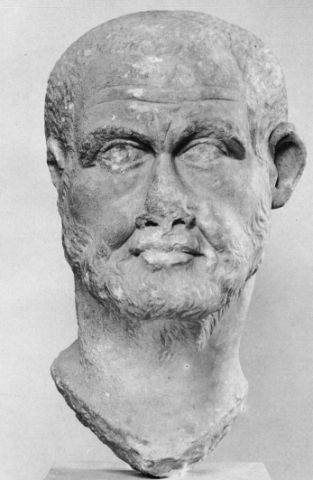
Worked for inscertion. The eyes and eyebrows are chipped; the rim of the right ear and the tip of the nose are chipped off.
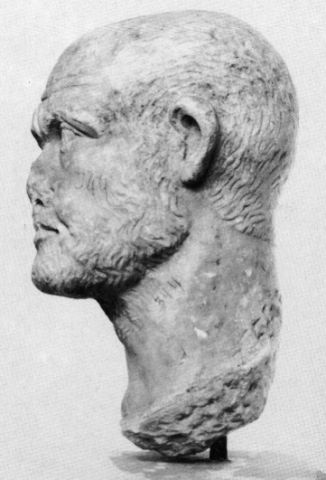
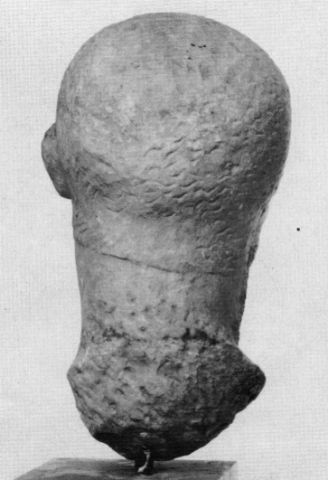
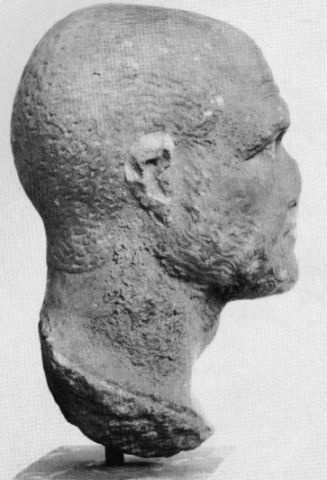
The hair is a compact mass surrounding the skull like a cap; in its present state it is the result of a late antique rework process. It is articulated by irregular short chisel strokes at the right side and by long concentric lines around the left ear. At the back, short wavy strokes are the remains of theoriginal hair. The beard is articulated by superficial irregular chisel lines which create the impression of a fluffy mass.
The cheeks are modelled in large areas; short and deeply incised naso labial folds separate the mouth from the cheeks. The brow is furrowed by two horizontal lines; a sharp vertical fold raises from the root of the nose.
PROVENANCE AND CURRENT LOCATION
There is no published record of the head’s provenance; Fuchs 1966, 80 n. 14 assumed that it was from Athens. It is today in the National Archaeological Museum in Athens, inv. no. 344.
DESCRIPTION (Subject)
The portrayed is an elder man with short cropped hair that recedes at the temples, and a trimmed beard that grows down onto the neck (see below, 'Date‘). His advanced age is indicated by the slack folds at his neck. He has a compact head with strong jawbones. The left ear is sticking out; this is possibly an individual feature, but it might be the result of the rework process (see above, 'Description (Object)‘). He has a fine sensual mouth; the folds on his brow and around his mouth signal strain and concentration.
DATE
The head was dated to the mid-3rd century and associated with the portrait of the emperor Traianus Decius (249-51) by Fuchs 1966; he was followed by Datsoule-Stavride 1985. Balty & Balty 1976 attributed the head to the emperor Claudius II Gothicus (268-70). Bergmann 1977 compared the hair which is concentrically arranged around the ears with the heads in the so-called Iamblichus type (LSA-79, LSA-110, LSA-111, LSA-112, LSA-113, LSA-114, LSA-115, LSA-116, LSA-894, LSA-2292); of these, the Athenian head LSA-114 and, to a lesser degree, the heads from Delphi LSA-110 and from Epidaurus LSA-115 show a similar articulation of the hair.
The stylistic features indicate a date in the mid/later 3rd century. The beard which is growing onto the neck takes up a fashion introduced into imperial portraiture by Gallienus (253-68) and fashionable in the pretetrarchic later 3rd century. The fashion beard makes a pretetrarchic date appear most probable; however, a date still in the tetrarchic era does not have to be ruled out categorically.
Discussion references
- Balty, J. & J. Ch. Balty, Notes d'iconographie romaine, II, Römische Mitteilungen 83, 1976, 175-93, 181-2 pl. 49, 1; 50, 2; 54, 1
- Bergmann, M., Studien zum römischen Porträt des 3. Jahrhunderts n. Chr., Bonn 1977, 158 pl. 47, 3-4
- Fuchs, W., Zum Antinoos Hope und 'Cacciatore' im Kapitolinischen Museum, Archäologischer Anzeiger 81, 1966, 76-86, 76-86 figs. 8-13, ad 80-3:
Cite: Last Statues of Antiquity, LSA-2292 (Ulrich Gehn).