
LSA-2293
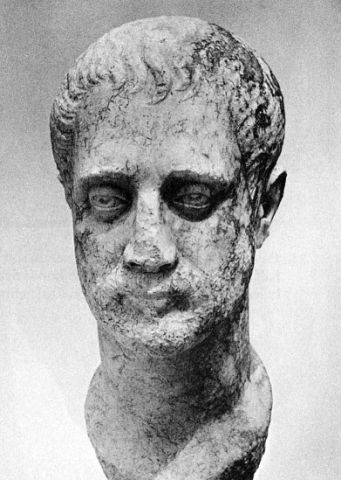
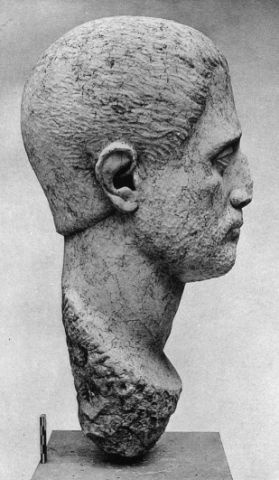
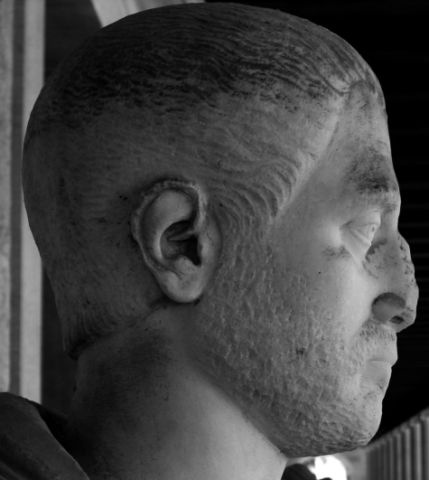
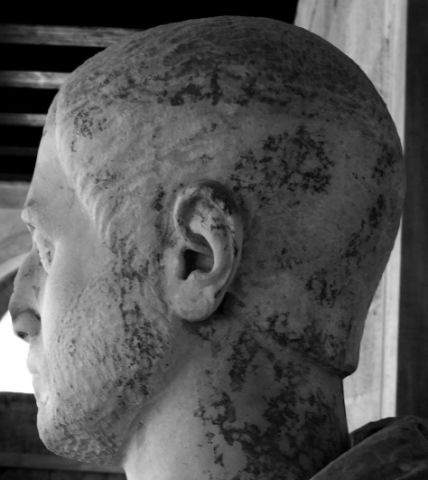
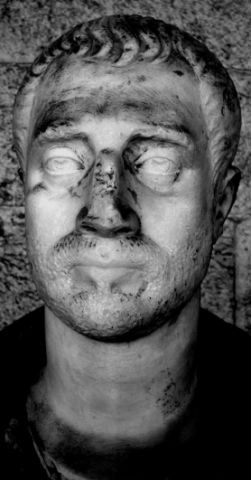
Portrait head of man with short beard, re-worked from earlier portrait. Athens. Mid to late fourth century
Record details
Photographs
Bibliography
- Harrison, E. B., Portrait Sculpture: The Athenian Agora I, Princeton, N. J. 1953, pp. 67-8 no. 52 pl. 34
Discussion
DESCRIPTION (Object)
Worked for insertion and currently mounted on a himation statue from earlier antiquity (statue = Harrison 1953 no. 58). The statue was likewise excavated on the Agora, on the eastern side of the north court of the 'Palace of the Giants' (see below, 'Provenance/ Location'), and it might well have been re-used in late-antiquity for the decoration of the 'Palace' (Harrison 1953, 74-5). The head fits loosely with the statue.
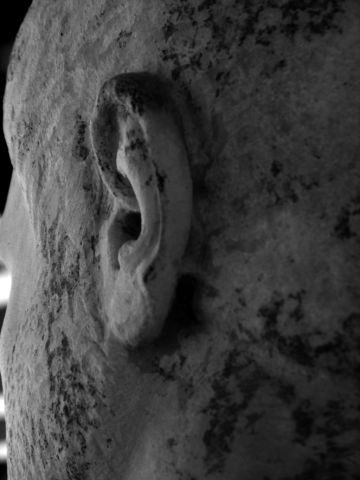
There are stains scattered over the surface, and the bridge of the nose is chipped; apart from that the head is in an excellent state of preservation.
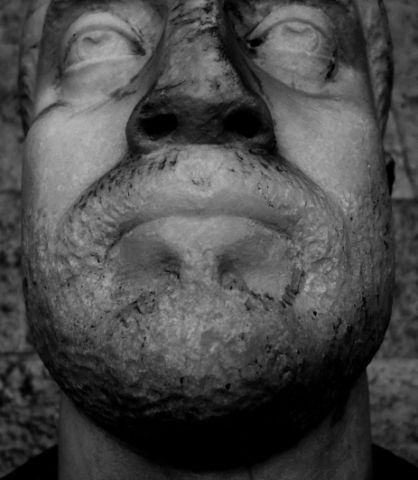
The hair rests like a tight-fitting cap on the skull, articulated by a flat chisel at front and sides; the strokes are of different length. In the back the hair is merely blocked out and dressed into an even surface. In the back, the hairline is sharply set off the neck by a continuous line; around the face it fringes out into short strands and into five long sinuous strands in the centre of the brow. The beard is picked directly into the surface by a flat point; on the upper lip it has some plastic substance. Its structure possibly indicates a trimmed short beard rather than a stubble beard.
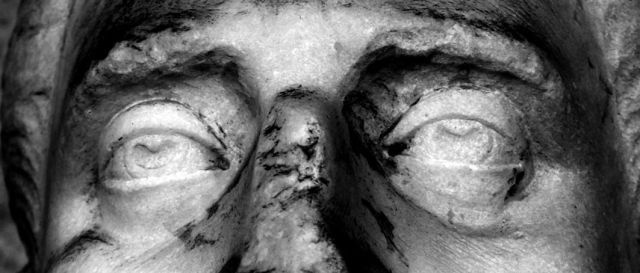
Tool marks around the eyes give proof that the portrait in its present form is the result of a late-antique re-work. The orbital is deeply cut out by a drill; a skin fold under the left eye indicates that a layer of material was removed to scalp the eyes into their present shape. The lids cover tightly the globular eyeballs leaving a semicircular aperture. The iris is circumscribed by a thin circular line, the pupil drilled into a crescent shape.
The rasp marks which appear all over the surface likewise belong to the late-antique re-work. Around the mouth less material was removed. Where the shape of the lower lip has been carved, a 'mouche' has been left which appears odd with the stubble beard.
PROVENANCE AND CURRENT LOCATION
The head was excavated in 1952 in a Byzantine house foundation west of the 'North Court’ of the 'Palace of the Giants’. This large peristyle court is situated in the central agora above the Odeion of Agrippa (hence Harrison’s description 'about 5 m. to the west of the central part of the Odeion (K 10)' (grid according to the map presented in Harrison 1953 pl. 49; on North court H. A. Thompson in Frantz 1988, 99-102)). Whether the portrait was part of the decoration in the 'Palace of the Giants’, or whether it was on display on the Agora (or whether it was even brought there from a place afar) is beyond our saying.
The head is today in the Agora Museum, inv. no. S 1604. It is on display mounted on a himation statue at the northern end of the east wall of the Stoa of Attalus (see above, 'Description (Object)').
DESCRIPTION (Subject)
The portrait depicts a man of mature age with short hair and short or stubble beard. The hair is receding over the temples and brushed forward into the brow to coat the incipient boldness. The expressively enlarged, staring eyes dominate the face; they signal alertness and attention. The stubble beard characterises a man in office rather than a model citizen and gives reason to the assumption that the depicted is a member of the militia, the imperial administration.
DATE
Harrison 1953, 68 saw the terminus post quem for our head in the forward brushed hairstyle which 'follows a post-Gallienian style which continues throughout Late Antiquity’; 'its timid acceptance of the more simplifying conventions of the Tetrarchic (sic) period’, however, led her to assign a late-3rd/ early-4th century date to our head.
In my view, the emphatically enlarged eyes of this non-imperial head indicate a date not earlier than the late 4th century.
Striking parallels, both technically and stylistically, are offered by the portraits of Cethegus from Rome (LSA-879) and of Virius Audentius Aemilianus, governor (consularis) of Campania, from Puteoli (LSA-46). The portrait head of Aemilianus resembles our head in the way the hair is re-cut and the beard is picked, and in the way the mouth is simply drawn as a cleft into the extant material. The portrait head of Cethegus offers a parallel for the laborious expansion of the eyes. Both heads are securely dated to the Valentinian period in the 360s/70s; they both secure that stubble beard is a possible choice for the portait of a Roman senator or a high ranking state official at that time.
The hairstyle of our Athenian head is without the 'coil' characteristic of portraits of state-officials of the Theodosian period and beyond. This property again is shared by the Cethegus and Aemilianus heads. While I think that a date in the mid-late 4th century is most favourable for our head, I would make the case for a pre-theodosian date at the same time.
Our broad outer dates from the late 3rd to the mid/ late 4th century account for the proposal offered by Harrison 1953.
Discussion references
- Frantz, A., Late Antiquity A. D. 267 - 700: The Athenian Agora XXIV, Princeton 1988
Cite: Last Statues of Antiquity, LSA-2293 (Ulrich Gehn).