
LSA-2294
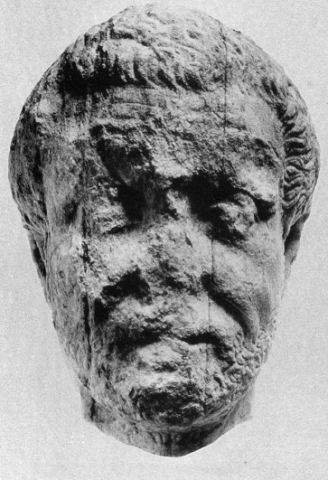
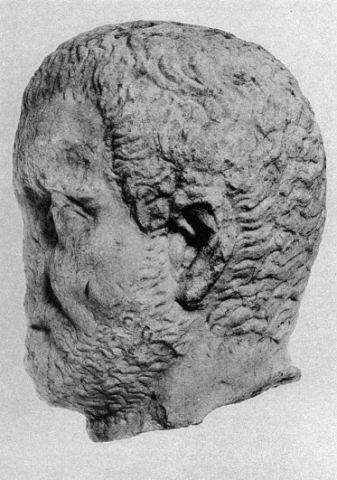
Portrait head of bearded man. Athens. Late third century
Record details
Photographs
Bibliography
- Harrison, E. B., Portrait Sculpture: The Athenian Agora I, Princeton, N. J. 1953, 64-5 no. 50 pl. 32
Discussion
DESCRIPTION (Object)
The head is broken in an horizontal plain at the neck. The nose is chipped off, the right temple, both eyebrows, eyes, lips, right cheek and chin are chipped. Two incisions from a modern tool run over the face, one through the right temple, the other one to the left of the nose. The surface on the right side is badly worn, better preserved on the left.
The hair is articulated by irregular short chisel strokes; longer crescent-shaped locks behind the left temple are relics from the original portrait from which our head was carved. The beard is articulated in the same technique as the hair.
The forehead is furrowed by two horizontal lines incised by a chisel. The flabby flesh of the cheeks is plastically modelled; deep naso-labial folds set the cheeks off the upper lip.
PROVENANCE/ LOCATION
The head was found 1947 in an early Byzantine wall in the valley between the Areopagus and the Hill of the Nymphs in Athens, west of the northwest spur of the Areopagus (Harrison 1953, 64; findspot in grid D 17 of map ibid. Pl. 49). This was a densely populated residental area in the 4th century (Frantz 1988, 35). The head is today in the Agora Museum, inv. no. S 1256.
DESCRIPTION (Subject)
Te portrayed is a man of mature age as indicated by the furrowed brow, the heavy naso-labial folds, and the flabby cheeks. His hair, however is still full and just slightly receding above the temples. His trimmed beard grows onto the throat.
DATE
Harrison 1953 dated the head to the tetrarchic period because of the parallels in the cut of beard and hair to the other portraits from Athens dated to that period (LSA-124, LSA-125, LSA-127). The 'restless asymmetries’ ('unruhige Verschiebungen') of the carnate claimed as characterizing feature for portraits of that period by L’Orange 1933, 39, however, are less obvious on our head (possibly due to the bad state of preservation notably of the left side, Harrison 1953, 65). The detailed modelling of the flabby cheeks reappears with the portrait head of a priest (Harrison 1953, 63-4 no. 49 pl. 31) dated to the post-Gallienian period by Harrison. While we are convinced by Harrison’s argument for a date in the late 3rd century, we would allow for somewhat broader outer dates including the late/ post-Gallienian era.
Discussion references
- Frantz, A., Late Antiquity A. D. 267 - 700: The Athenian Agora XXIV, Princeton 1988
- L'Orange, H. P., Studien zur Geschichte des spätantiken Porträts, Oslo 1933
Cite: Last Statues of Antiquity, LSA-2294 (Ulrich Gehn).