
LSA-2295
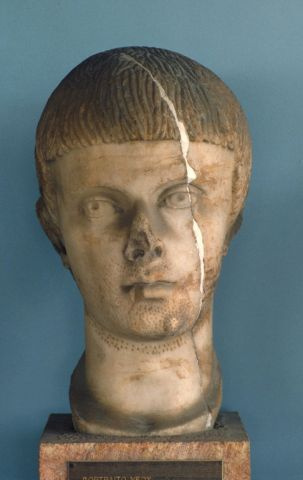
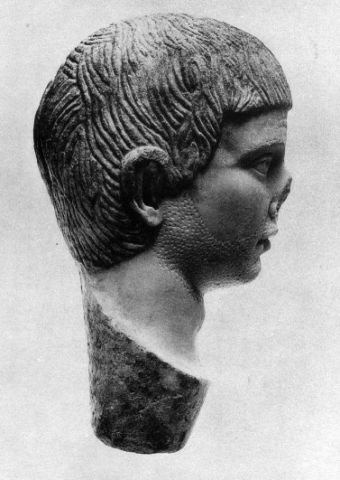
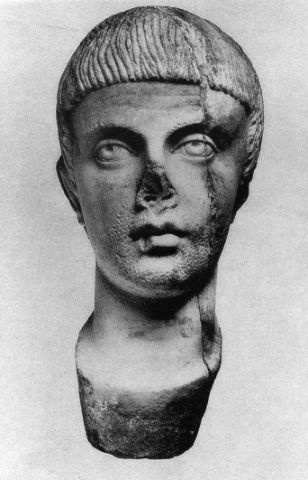
Portrait head of young man with stubble beard, re-worked from earlier portrait. From Athens. Mid third to fifth century
Record details
Photographs
Bibliography
- Harrison, E. B., Portrait Sculpture: The Athenian Agora I, Princeton, N. J. 1953, pp. 65-7 no. 51 pl. 33
Discussion
DESCRIPTION (Object)
Worked for insertion and preserved with its full neck. Pentelic marble, H (overall) 40.5, (chin to crown) 24, W 19 cm. The head is broken into two pieces by a crack running vertically through the left eye and cheek. The crack is accompanied by cracks, notably at the left eyebrow. The tip of the nose and the right edge of the lower lip are broken off; the right earlobe is superficially chipped, the top of the left ear is chipped (Harrison 1953, 65). The cone for the insertion is out-centred to the left (from the viewer), its surface is smoothly finished; at the back it reaches up almost to the hairline. Harrison 1953 noted traces of red paint on the lips.
The hair is a tight fitting cap set off the flesh by a continuous line. Single strands are rendered as noodle-like bulks by drawn-out lines with the chisel. They are directed towards the bow at the front, but deliberate in length and directions at the right side thus forming an illogically overlapping pattern. The beard is picked with a point directly into the flesh. Eyebrows are articulated in the same manner as the beard.
The iris is circumscribed by an incised circular line; the pupil is a round or elliptical drill-hole set immediately below the upper lid.
The cheeks are plain with no modellings; two horizontal furs, the lower slightly concave, are engraved into the brow by a flat chisel.
The stubble beard picked directly into the flesh and the way the crudely worked ears are pressed into the contour are indicators that the head in its present state is the result of a late-antique re-work. Harrison 1953, 66 reports that ‚the cavity of the left ear is over-large and oddly shaped’ (not visible on any of the published photos); a further indicator. The wrinkles on the forehead must be from the same process of re-working the head.
PROVENANCE/ LOCATION
The head was found 1949 built into a late Roman wall in front of the Stoa of Attalus (see below, 'Date').
It is today in the Agora Museum, inv. no. S 1406.
DESCRIPTION (Subject)
The portrait depicts a young man with dense hair brushed ino the forehead, his view gazing upwards to the right hand side. No wrinkles disturb the youthful smoothness of his face to which the roughly engraved stubble beard is in marked contrast. The beard and together with it the horizontal wrinkles on the brow mark a certain degree of maturity despite the young age of the portrayed.
The hair forms an almost horizontal line above the forehead and bends in an obtuse angle above the temples. Between temples and ears the hairline is in the shape of a quarter-circle.
DATE
The wall in which the head was found has been dated to the 3rd quarter of the 5th century (A. W. Parsons, Hesperia 5, 1936, 70-90; Frantz 1988, 81). This provides the terminus ante quem for our head. Already the first publisher of the head, H. A. Thompson, pointed out that the wall contained much material 'that had undoubtedly been damaged in the Herulian sack of A. D. 267’ (Thompson 1950, 332); the head dated, so Thompson concluded, with some probability before 267. This argument was adopted by Harrison 1953. An alternative assumption would be that the head was from the late, post-Herulian phase of the Agora. The Agora was used as an industrial area after the Herulian incursion only to be re-shaped into a representative public space with the building of the ‚Palace of the Giants’ around 400. This would suggest, under the given proposition, a 5th century date for our head.
As earlier scholarship has remarked, this singular head does not readily yield to classification. The closest parallel for the highly unusual way of rendering the hair appears to be a head found in Olympia (Treu 1897, 249 fig. 283 d; LSA-2493). The Olympia head was dated tentatively to the 3rd century by the publishers; it can not, however contribute anything to a safer date for our head.
Thompson 1950, if cautiously, compared the head to portraits of Gordian III ('Gordianus II’ is probably a print error; 'handling of the flesh') Maximinus Thrax (hairline), and Trebonianus Gallus (stubble beard and treatment of the eyebrow; Thompson 1950, 331 with n. 30).
In my opinion, Thompson's comparisons to portraits in the 1st half of the 3rd century are much better sustainable than any approach to settle the head in the 5th century. The hairline, horizontal above the forehead and sinuous at the temples is paralleled not only by portraits of Maximinus Thrax, as Thompson had suggested, but also of youthful princes and emperors of that period like Maximus Caesar and Gordian III. Thompson's comparison to the latter might be supported by the observation that several portraits of that emperor display the contrast of youthful smoothness and linear furrows engraved on the brow (togate bust of Gordian III in Berlin).
Discussion references
- Treu, G., Die Bildwerke von Olympia in Stein und Ton (Olympia. Die Ergebnisse der von dem deutschen Reich veranstalteten Ausgrabungen III), Berlin 1897, 249 fig. 283 d
Cite: Last Statues of Antiquity, LSA-2295 (Ulrich Gehn).