
LSA-2298
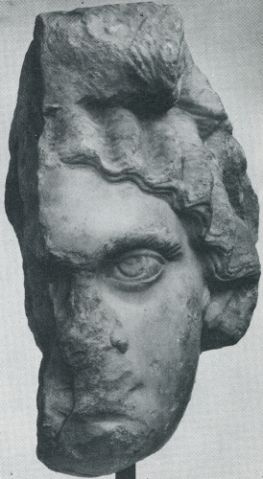
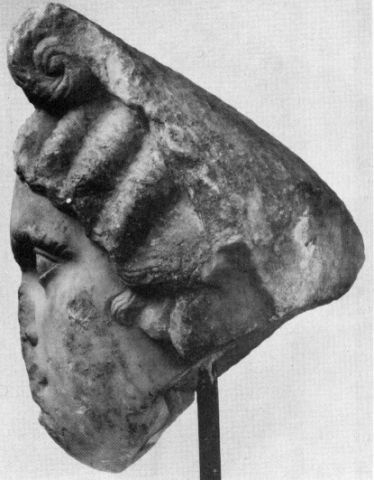
Fragment of female portrait head with central braid. From Athens. Late third to earlier fifth century
Record details
Photographs
Bibliography
- Datsoule-Stavride, A., Hysteroromaika Portraita 2ou - 4ou m(eta) Ch(ristou) Aiona sto Ethniko Archaiologiko Mouseio Athenon, Archaiologike Ephemeris 1981, 127-38, Athens 1983, p. 133 no. 793 pl. 49 b-g
Discussion
DESCRIPTION (Object)
Left half of a female portrait head, neck broken; pentelic marble, H 28, W 16.1, D 16 cm (all measurements from Datsoule-Stavride 1981, 133 n. 4). Nose and chin are broken off, the lips are damaged, and further chips are scattered on face and hair. The front and the left edge of the braid are chipped.
Around the face and on the front of the braid, single strands of hair are separated by continuous (drilled or chiselled) lines; on the skull the pattern of the hair is engraved with a flat chisel. The braid is executed only at the front whereas at the back it is an undifferentiated layer, just roughly finished.
The eyes are protruding; the pupil is circumscribed by a circular line with chisel or drill, the iris stands proud; the inner ankle of the eye is marked by a drill hole. The eyebrows are marked by vertical chisel strokes
PROVENANCE/ LOCATION
There is no published record on the provenance of the fragment. Today it is in the store-rooms of the National Archaeological Museum in Athens, inv. no. 793.
DESCRIPTION (Subject)
The portrait depicts a woman with an elaborate hairstyle. The hair is parted at the centre and curled into a 'melon'-coiffure with long sinuous strands around the brow; the upper half of the ear is covered. In the back it is combined into a broad central braid which is looped upwards and reaches the forehead; at its tip the braid is twisted into a spiral. In front of the left ear a little lock is hanging loose.
DATE
The fashion hairstyle with the central braid ('Scheitelzopffrisur') reaching the forehead and twisting into a spiral first appears on coin portraits of the empresses Ulpia Severina (270-5) and Magnia Urbica (283-5) in the late 3rd century (Schade 2003, 12, 25-7). The fragment has been dated, probably for this reason, into the last quarter of the 3rd century by Datsoule-Stavride 1981.
The coin portraits of Ulpia Severina and Magnia Urbica can only provide a terminus post quem for our portrait. The hairstyle with the central braid remains a possibility for female self-representation throughout the 4th and into the 5th century, both in imperial and in non-imperial portraiture (Schade 2003 53-4,pl. 2,1 (Galeria Valeria; 3,3; 3,4; 3,6; 3,7 (Helena), 4,1 (Flacilla); 4,2 (Aelia Eudoxia), 4,3 (Pulcheria); 4,4 (Galla Placidia); Schade l. c. 95-6. Non-imperial portraits: clipeus-portrait on sarcophagus in Rome, Villa Savoia, Schade l. c. pl. 16, 1; clipeus-portrait on sarcophagus in Tolentino, cathedral, Dresken-Weiland 1998, 52-4 no. 148 pl. 57, 4; bust in Thessalonica LSA-91).
A late-4th or early-5th century date is preferable: the fragment displays a very elaborate version of the central braid, which resembles the one displayed by the Thessalonica-bust LSA-91 (this is reliably dated to the brink of the 5th century by the accompanying male bust LSA-90); the late-3rd century versions of this hairstyle, on the other hand, are less voluminous and less elaborate.
Here the central braid, which runs up the back of the head, is unusually broad, covers most of the ears, and is not, in fact, braided until it reaches the height of the ears. In these details this portrait diverges from the metropolitan examples and best resembles other portraits from Asia Minor, LSA-433, LSA-434, LSA-435. Thus, it seems best to place the head in a wider chronological range.
Discussion references
- Dresken-Weiland, J., Repertorium der christlich-antiken Sarkophage. Zweiter Band. Italien mit einem Nachtrag Rom und Ostia, Dalmatien, Museen der Welt, Mainz 1998
- Schade, K., Frauen in der Spätantike--Status und Repräsentation, Mainz 2003
Cite: Last Statues of Antiquity, LSA-2298 (Ulrich Gehn).